
In browser automation, public data collection (such as SEO rank monitoring, e-commerce price comparison and price monitoring), QA regression testing, and AI Agent workflows, captcha recognition is the infrastructure that keeps pipelines running. Whenever quarterly budget reviews or vendor switching cycles come up, technical leads and procurement teams put "captcha platform cost comparison" on the agenda.
In our previous articles "Captcha Platform Cost Comparison: Public Pricing, Billing Caliber, and Real Cost Algorithms of Mainstream Platforms" and "How to Calculate Captcha API Success Rate: Three-Tier Caliber, Formulas, and Effective Cost", we have already derived in detail how to calculate the effective cost per solve by combining "API return rate" and "target site pass rate". However, recently many engineering teams that migrated from other platforms reported a more troublesome phenomenon: even if the public unit price and recognition rate are calculated precisely, the actual total expenditure (along with supporting server, proxy, and R&D labor costs) during monthly financial reconciliation is still often 30% higher than the estimated value.
Industry evaluations and selection practices in 2026 show that evaluating captcha recognition services can no longer rely solely on the static "X dollars per 1,000 calls" on the price list. The rigid losses of billing models, resource consumption of architecture polling, order splitting for long-tail captchas, and engineering investment in API refactoring together constitute the Total Cost of Ownership (TCO) for enterprise procurement. This article takes a different perspective, starting from the full cycle of commercial terms, engineering links, and migration implementation, to help you calculate the five "hidden accounts" behind captcha platforms.
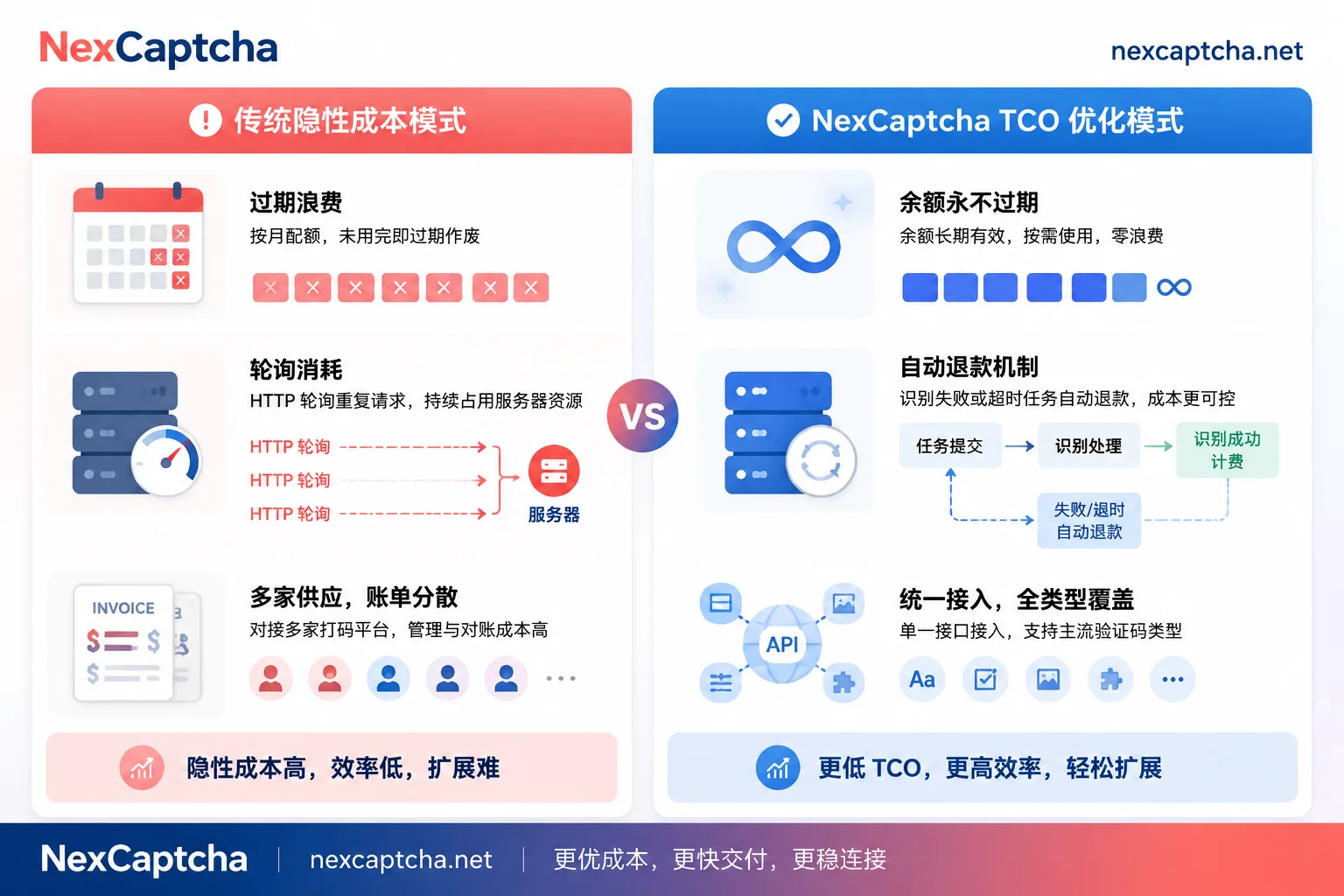
I. Hidden Losses in Business and Financial Dimensions: Are You Paying for "Calls" or for "Rules"?
When comparing captcha platform costs, the first screening threshold is often not the unit price, but the platform's commercial settlement rules. Different billing models exhibit completely different cost curves when business volume fluctuates.
1. Subscription monthly fees, concurrent thread fees, and balance expiration traps
Some captcha services on the market use "fixed monthly subscription," "buyout by concurrent threads," or "limited-time traffic packages." This model may seem cost-effective under ideally stable traffic, but in real collection and testing scenarios, it easily leads to sunk costs:
- Peak-valley mismatch: Traffic often bursts during e-commerce promotion price comparisons, monthly SEO rank surveys, or concentrated QA regressions before releases. If you purchase monthly packages or concurrency packages based on peak values, a large amount of quota will be directly zeroed out during off-peak periods; if you purchase based on average values, peak periods will trigger rate limiting and cause widespread business timeouts.
- Who pays for failures and timeouts: Some platforms charge by "request initiation" or "computing power occupied." Once network jitter or task timeout occurs, fees are still deducted.
When comparing such terms, a more robust financial model is pure pay-per-use deduction with automatic tiered discounts. Taking NexCaptcha pricing as an example, the platform has no subscription fee, no minimum consumption threshold, and account balance never expires. The billing logic is strictly bound to task status: tasks are divided into processing, success, failure, and expired states. When a task fails or expires, the fee is automatically refunded to the balance; meanwhile, as team call volume crosses thresholds, the system automatically triggers volume discounts, without the need to lock in large annual contracts in advance.
2. Payment compliance and trial-and-error threshold for enterprise procurement
For domestic development teams and multinational business departments, the friction cost of fund settlement cannot be ignored either:
- Single payment channel: Some overseas low-price platforms only support specific cryptocurrencies (Crypto only) or overseas credit cards, which not only incurs exchange rate and handling fee losses but also makes it difficult for corporate finance to go through compliant reimbursement processes.
- High minimum deposit and card binding restrictions: Even during the testing phase, they require binding a credit card or recharging tens of dollars, raising the trial-and-error cost of horizontal evaluation across multiple platforms.
To reduce friction in procurement and financial processes, NexCaptcha uses transparent USD pricing and supports Alipay, WeChat, USDT, and corporate bank transfers; new users who register and obtain an API Key receive test credits and can run real pipelines in the console without binding a card.
II. Associated Costs in Architecture and Links: Why Does a Captcha API Inflate Your Server and Proxy Bills?
Many teams, when calculating captcha costs, are accustomed to looking at the "captcha API bill" and "cloud server/proxy IP bill" separately. But in fact, the architectural design of the captcha API directly determines the consumption rate of upstream and downstream resources.
1. Computing power and connection overhead caused by high-frequency polling
In traditional asynchronous captcha workflows, after submitting a task, the client needs to call a query API every few seconds to get the result. If the platform processes slowly or only supports polling, your automation cluster (especially headless browser instances running Puppeteer, Playwright, or Selenium) must remain suspended.
- Memory and instance occupancy: A headless browser context typically occupies hundreds of MB of memory. Every 10 seconds waiting for a captcha response is real money lost in cloud host CPU and memory (for troubleshooting slow tasks, see "What to Do When a Captcha Task Keeps Processing").
- Invalid network overhead: Thousands of invalid HTTP polls under high concurrency consume local outbound bandwidth and easily trigger network-level connection limits.
In terms of architecture selection, NexCaptcha automated captcha solving API not only provides standard create.cgi (create task) and query.cgi (query result) HTTP endpoints, but also natively supports WebSocket result push (for implementation details, see "How to Connect Python Captcha Recognition API: Asynchronous httpx Wrapper, WebSocket Push, and Playwright Integration"). Once a task is completed, the server actively pushes the result back to the client, eliminating polling intervals and significantly shortening the lifecycle of each browser instance.
2. Synergistic costs of session isolation and proxy pools
When dealing with high-risk captchas (such as reCAPTCHA Enterprise, Cloudflare Turnstile, DataDome, Imperva, etc.), the biggest waste is often not recognition failure, but "recognition succeeded and obtained a token, but submission to the target site was rejected."
This usually happens because some black-box solutions try to send requests on behalf of the customer, causing the network egress, TLS fingerprint, or session state of the captcha-solving environment to be inconsistent with the customer's local submission environment. To clarify boundaries and control proxy costs, NexCaptcha adopts a clear session decoupling and proxy tiering strategy:
- Session security and state alignment: Customer business requests, sessions, and cookies do not pass through NexCaptcha services at all. The API only asynchronously returns
token,cookie, text, or coordinates based on parameters such as the page URL,sitekey, or image, and the customer ultimately submits with their own session along with the form. - Flexible proxy cost control: For different captcha types' risk control mechanisms, some types allow optional proxy passing, and some strong verification types require the customer's own proxy to ensure IP consistency; for types that do not require binding to a specific egress, if no proxy parameter is passed, the system directly uses NexCaptcha's built-in proxy pool to complete recognition, directly saving teams a considerable amount of third-party proxy traffic fees.
3. Maintenance costs of multi-platform "order splitting"
If a business involves both overseas and domestic sites, it often encounters a dilemma where overseas platforms cannot solve "Geetest, Tencent, NetEase Yidun, Alibaba Cloud," while traditional domestic OCR platforms cannot solve "Turnstile, FunCaptcha/Arkose, AWS WAF." Maintaining balances, alerts, bills, and client code for more than three captcha platforms is itself a huge operational burden.
Covering all scenarios with a single API is key to reducing maintenance costs. In NexCaptcha supported captcha types, one API Key can uniformly schedule:
- Overseas mainstream and advanced risk control: reCAPTCHA v2/v3/Enterprise (including invisible), Cloudflare Turnstile, FunCaptcha/Arkose, DataDome, AWS WAF, Imperva, MTCaptcha, Friendly Captcha, ALTCHA, Yandex SmartCaptcha, KeyCaptcha, Capy, Lemin, atbCAPTCHA, etc.
- Domestic mainstream and general interaction: Geetest v3/v4, Tencent Captcha, NetEase Yidun, Alibaba Cloud Captcha, as well as general types such as image, slider, click, rotate, and audio.
- Long-tail customization: If you encounter uncommon types not yet in the console product catalog, you can directly send samples for quotation, avoiding the engineering team having to build models temporarily (for a cost comparison between self-building and procurement, see "Self-Build vs. Captcha Platform for Captcha Recognition?").
III. Special Bills in the AI Agent Era: Don't Let LLM Tool Calls Become a "Money Pit"
As more teams introduce Claude Code, Cursor, Gemini CLI, or self-developed AI Agents into automated testing, RPA, and data collection workflows (see "Enterprise Data Collection Strategies from the Perspective of Anti-Scraping Upgrades"), a new hidden cost is emerging: the trial-and-error call cost of AI assistants.
If you have a hand-written script calling the API, the parameter format is hardcoded; but if you let an LLM-driven Agent handle captchas, the Agent often needs to first explore available types, verify parameter structures, submit tasks, poll status, and confirm account balance. If the underlying integration is cumbersome, it not only requires local deployment and maintenance of middleware but may also trigger invalid charges due to LLM hallucinations.
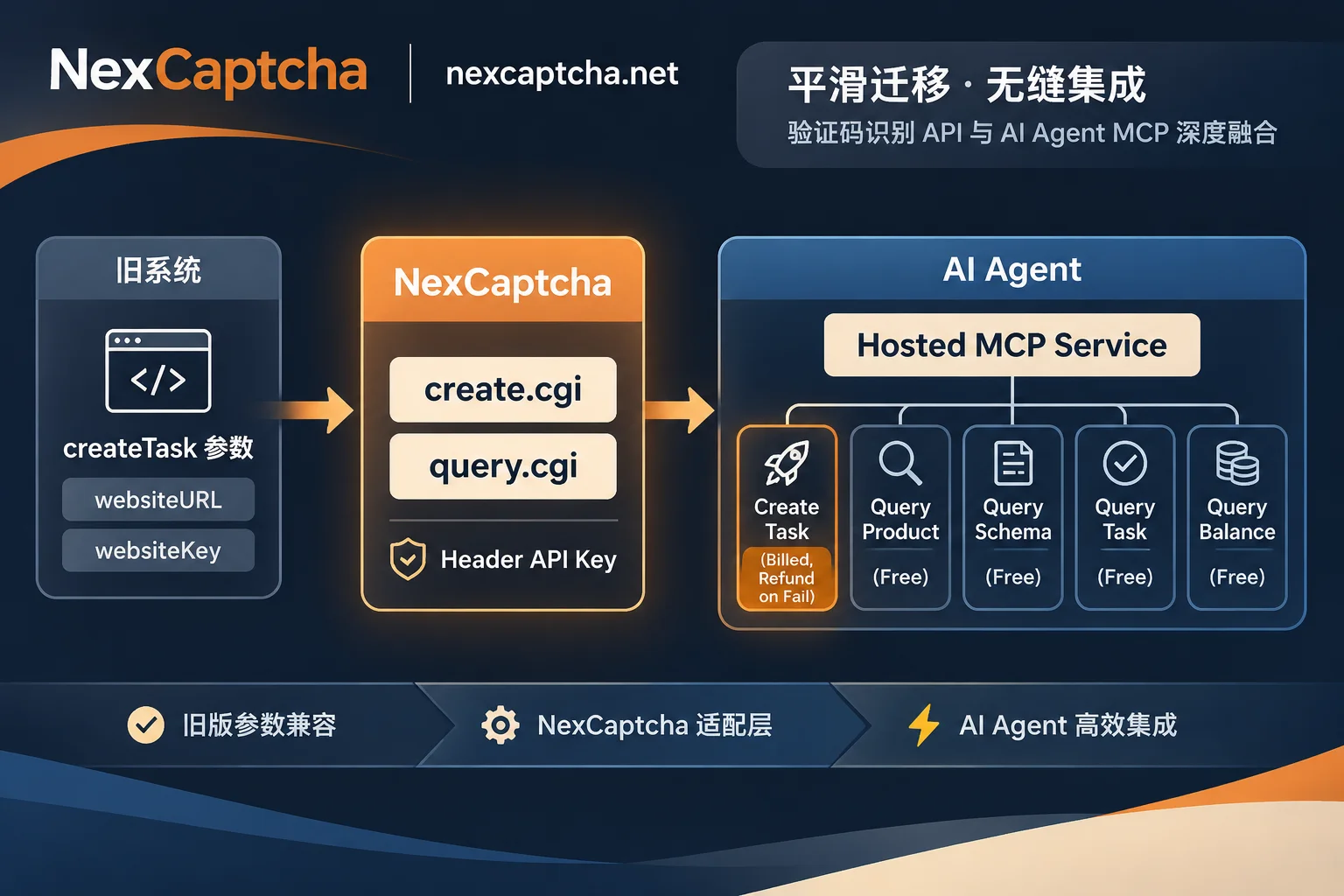
To address this trend, NexCaptcha hosted MCP service has made dedicated cost isolation and lightweight design at the protocol layer:
- No local deployment: Provides a standard hosted service, supports Claude Code, Claude Desktop, Cursor, Codex, VS Code, Gemini CLI, and any client supporting Streamable HTTP. Authentication is done by filling in the API Key.
- Fine-grained tool boundaries and zero-charge queries: The MCP service exposes five standard tools—query products, query parameter models, create task, query task, query balance. In terms of billing rules, only "create task" triggers charges (and failed or expired tasks are automatically refunded). The Agent's repeated calls to "query products," "query parameter models" before decision-making, or "query task," "query balance" after execution do not incur additional platform fees, completely eliminating financial waste from AI trial and error.
III. Engineering Cost Accounting for Platform Migration: How to Switch with Minimum R&D Person-Days?
When comparing captcha platform costs, many technical leads know that their current vendor's unit price is high and response is slow, but they hesitate to make the switch. The core concern is the engineering refactoring cost of migration (as industry analysis points out, clear documentation and smooth API design can greatly reduce the hidden cost of debugging and integration).
To help teams calculate R&D investment before migration, we need to objectively and transparently explain the similarities and differences between NexCaptcha's API design and old platforms (such as 2Captcha, Anti-Captcha, CapSolver, etc.):
1. Which parts need to be rewritten? (Assessing refactoring cost)
NexCaptcha's API is not the traditional createTask/getTaskResult top-level JSON format, so existing code cannot be migrated simply by replacing the domain name. The R&D team needs to invest a little time to rewrite the request outer layer and authentication logic:
- Routing and authentication: Requests are uniformly sent to
create.cgi(create) andquery.cgi(query), with the API Key uniformly placed in the HTTP request header for authentication. - Outer structure: Specify the captcha type via product code, and encapsulate the specific business parameters of that type within the
adapterobject. - Result retrieval: The API documentation does not provide HTTP callbacks (Webhook), nor does it have a heavy third-party SDK that requires additional verification and installation. Results are uniformly obtained through lightweight WebSocket push or
query.cgiquery API (the official API documentation directly provides out-of-the-box HTTP and WebSocket sample code).
2. Which parts can be reused directly? (Reducing migration effort)
To avoid developers having to re-scrape parameters from web pages or rewrite business logic, NexCaptcha has made its adapter internal structure highly compatible:
- Common naming reference: Under each captcha type in the API documentation, the industry-standard
task typename is clearly marked (e.g.,RecaptchaV2TaskProxyless). - Core fields retained: The parameter fields within
adapterdirectly follow the customary usage of thecreateTasksystem (such aswebsiteURL,websiteKey, etc.). This means your existing parameter extraction scripts hardly need to change; you only need to wrap a thin Adapter conversion function at the request sending layer (for specific migration cases, see "How to Choose a 2Captcha Alternative", "How to Migrate from Anti-Captcha", and "How to Choose a CapSolver Alternative").
IV. Practical Implementation: Four Steps to Run Through "Real Cost Comparison" and Smooth Migration
Paper-based captcha platform cost comparisons can never replace testing with real business traffic. Since specific unit prices, volume discounts, P50/P95 response times, and acceptance rates for each type are subject to real-time disclosure on the official website, we recommend that technical and procurement teams follow these four steps to complete real TCO measurement and switching at minimum cost:
| Evaluation Phase | Key Actions | Cost Control Checkpoints |
|---|---|---|
| 1. Zero-code trial in console | Claim free test credits and use the online test bench in the console | Each captcha type has an online test bench. Enter your API Key to initiate a real task and quickly verify whether parameter extraction for the target site is correct. |
| 2. Outer wrapper and integration | Write the request outer layer according to the documentation comparison table, and connect to WebSocket | Check the adapter field mapping to ensure failure and expiration states are correctly captured and do not trigger blind infinite retries. |
| 3. Dual-run by traffic proportion | Route 10%~20% of real online traffic to the new channel in parallel with the old platform | Focus on comparing within the same time window: (total actual charges ÷ final target site pass count) and the average suspension time of headless browsers. |
| 4. Reconciliation and full switch | Verify bill details, refund records, and tiered discounts during the dual-run period | After data and stability match, gradually increase the proportion until full takeover, completely eliminating single-point switching risks. |
Conclusion: Compliance Boundaries and Rational Selection
The ultimate goal of captcha platform cost comparison is to use a more transparent and controllable unit cost in exchange for long-term stable operation of automated testing, AI Agents, and public data collection (for detailed business matching, see NexCaptcha industry scenario solutions).
Finally, it is important to note that healthy cost optimization is built on strict technical compliance. NexCaptcha only provides pure captcha recognition API services (it does not send requests or retrieve pages on behalf of customers, nor is it a SMS verification or account appeal service). It is strictly prohibited to use for credential stuffing, account theft, bulk registration, spam sending, evasion of bans, payment fraud, or bypassing paywalls or DRM—keys that trigger compliance red lines will be directly disabled without refund. Maintaining compliance boundaries is the first prerequisite for enterprises to control hidden risk costs.
If your team is conducting a vendor cost review or architecture migration evaluation, you are welcome to directly register a NexCaptcha account to claim test credits for dual-run testing, or contact us via the official Telegram support channel to discuss volume discounts for major promotions and custom solutions for long-tail captchas.



