
In e-commerce operations, independent site product selection, and market research, competitors' dynamic price adjustments often occur during evening traffic peaks or at critical points of major promotions. If the price comparison pipeline is interrupted at such times due to anti-scraping strategy upgrades, it will not only cause data gaps in the monitoring dashboard but also directly delay the price adjustment decision window.
Unlike keyword scraping from a single search engine, public price monitoring often requires inspecting dozens of retail platforms and independent sites with different technology stacks simultaneously. When engineering teams advance public price monitoring CAPTCHA handling, the biggest headache is usually not how to solve a particular CAPTCHA, but how to reliably run all target sites with a unified architecture under high concurrency and stringent geo and session requirements, and ensure that the price and inventory data stored in the database are authentic and valid.
This article starts from the real engineering pipeline of price comparison scraping and breaks down interception feature classification, session and geo-context maintenance, unified CAPTCHA solving API scheduling, and data cleaning strategies before database insertion.
I. Why Does Public Price Monitoring Frequently Get Stuck at the CAPTCHA Stage?
When the number of monitored SKUs expands from dozens to tens of thousands and the inspection frequency shortens from daily to hourly or even minute-level, the scraping architecture will collectively expose three typical interception pain points:
- Highly Fragmented Protection Systems
Cross-border independent sites and European/American retail platforms extensively use Cloudflare Turnstile, DataDome, AWS WAF, Imperva, and reCAPTCHA v2/v3/Enterprise; while comprehensive e-commerce and vertical platforms in the Asia-Pacific region commonly deploy GeeTest v3/v4, Alibaba Cloud, Tencent, or NetEase Yidun slider and click CAPTCHAs. If each site maintains a separate parsing script, maintenance costs will spiral out of control linearly with the number of sites. - Prices Strongly Bound to Geo and Session
For many retailers, prices, shipping fees, inventory status, and even currency units directly depend on the current request's geographic location (zip code/delivery area), cookie session, and egress IP. Once a CAPTCHA is triggered, if you simply discard the current session and directly switch IP to retry, you not only need to reinitialize the geo and zip code state (consuming several additional pre-requests), but also fall into a vicious cycle of "switching IP triggers new interception" when the new IP pool quality is poor. - Hidden "Soft Interceptions" Pollute the Price Comparison Database
Some WAFs, when determining a request as suspicious but not completely blocking it, do not return the standard403status code, but instead return200 OKwith an embedded CAPTCHA challenge page, or silently redirect to a fallback page with no inventory. If the parsing layer does not properly identify interceptions, it is easy to parse the price as0or directly misjudge it as "product delisted", thereby triggering false price reduction or out-of-stock alerts.
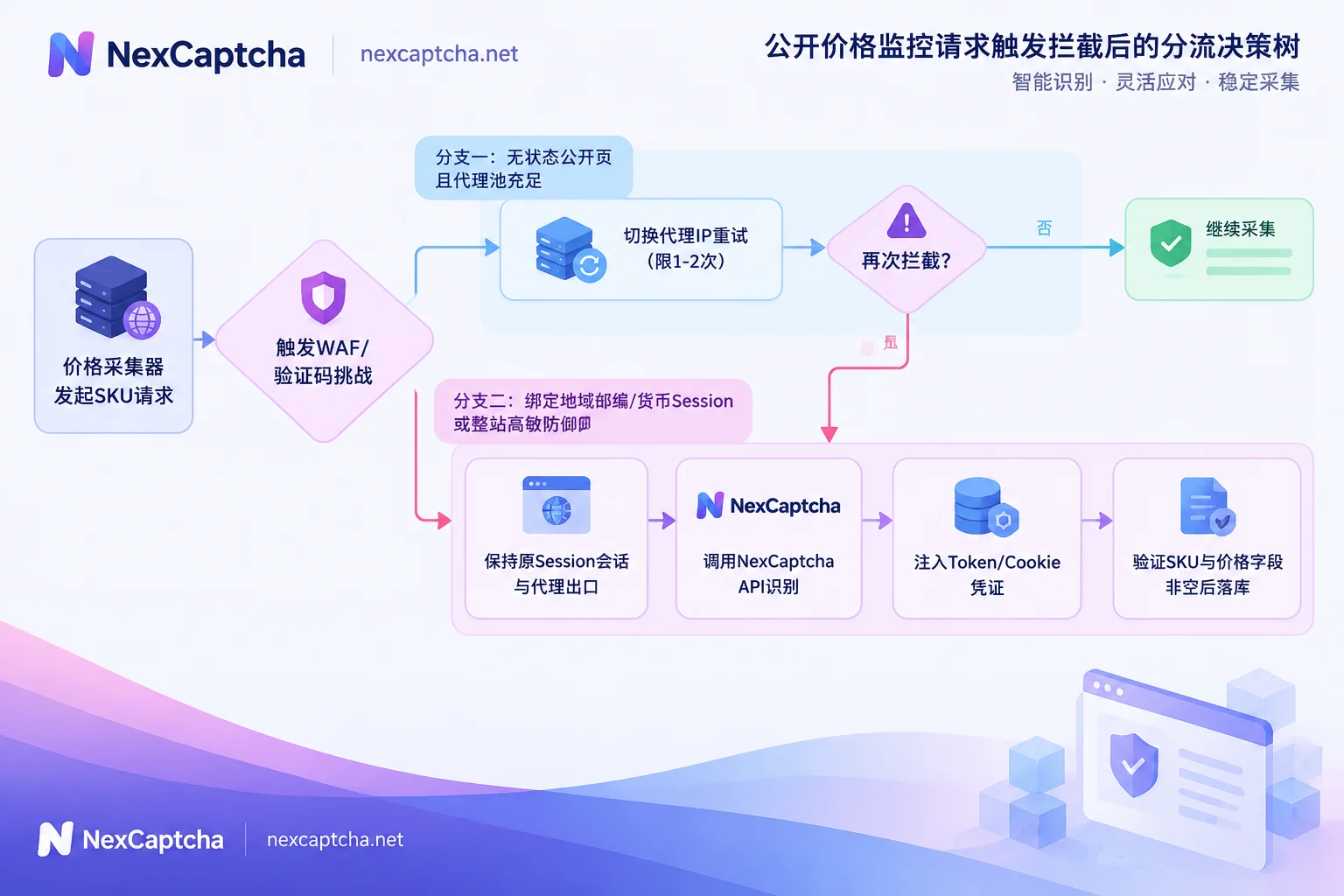
II. Interception Routing: After Triggering Verification, Should You Switch IP or Call the CAPTCHA Solving API?
In price inspection tasks, not all interceptions are worth calling recognition services, nor can all situations be solved by rotating proxies. It is recommended to establish the following routing rules at the scraping scheduling layer (if you also maintain search engine ranking monitoring, you can refer to the similar routing ideas in How to Handle CAPTCHAs in SERP Scraping):
| Inspection Scenario Characteristics | Recommended Handling Strategy | Core Reasons and Cost Considerations |
|---|---|---|
| Stateless public detail pages + sufficient high-quality proxy pool | Prioritize switching proxy IP and retry (limit 1-2 times) | Pages do not require pre-set cookies; switching IP costs less than recognition time; if 2 consecutive IP switches both trigger interception, immediately switch to CAPTCHA solving process. |
| Sessions requiring binding to zip code/delivery area/currency | Call CAPTCHA recognition API in place | Reinitializing geographic location and localization cookies requires multiple additional requests; maintaining the original session to pass the challenge has lower overall time and proxy bandwidth cost. |
| Whole site under high-sensitivity defense (during major promotions/Black Friday) | Fixed session + CAPTCHA recognition API + credential reuse | Target site applies indiscriminate challenges to all new sessions (e.g., Turnstile or DataDome); blind IP switching only increases failure rate; after obtaining verified cookies/tokens, continuously scraping multiple SKUs within the validity period is more cost-effective. |
| List pages requiring pagination or carrying dynamic search state | Call CAPTCHA recognition API in place | List pagination depends on context state or encrypted cursors; interrupting the session will invalidate the cursor, forcing a restart from the first page. |
III. Unified Integration Architecture: Use One API to Handle Multi-Platform CAPTCHAs
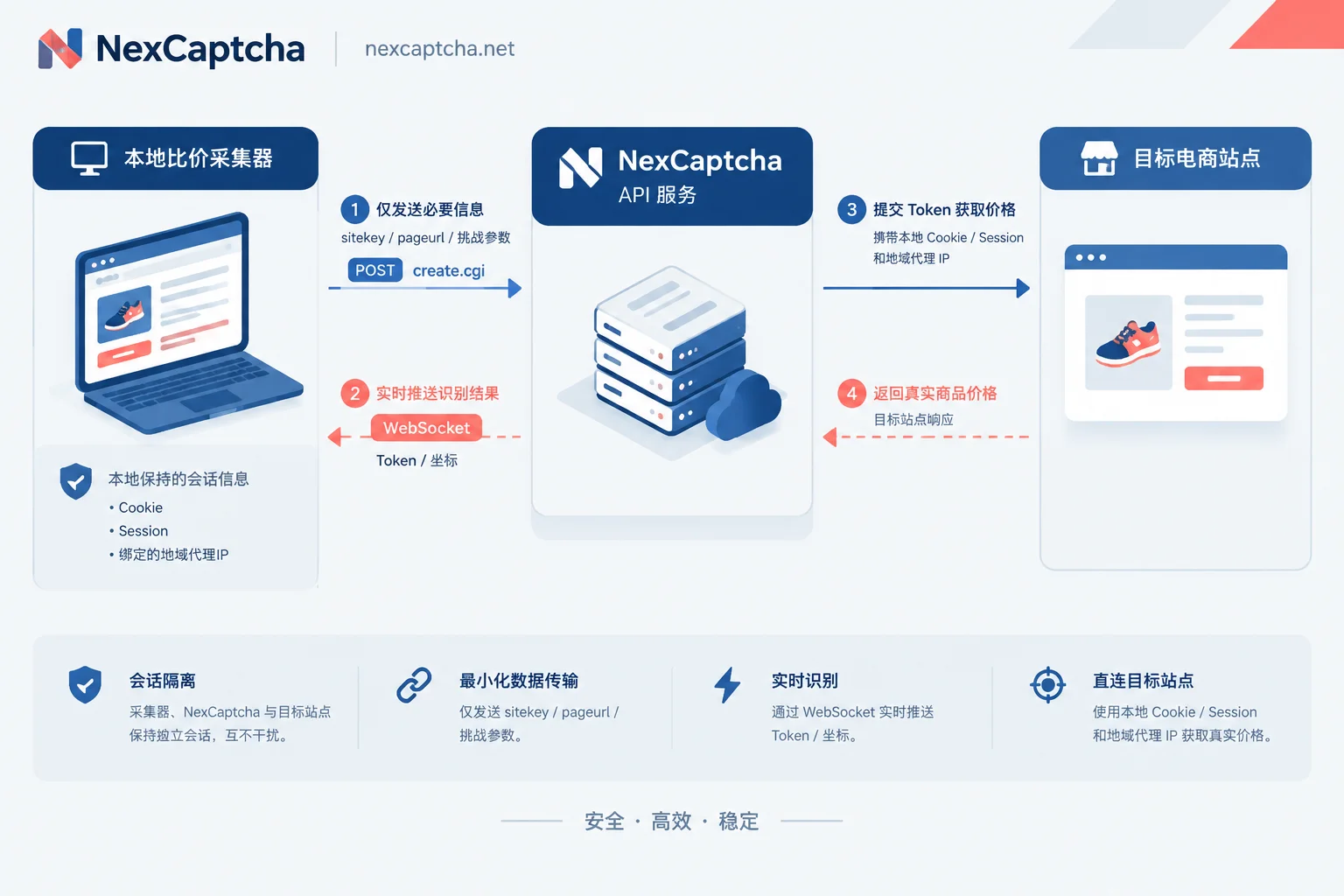
To avoid maintaining a dozen completely different CAPTCHA solving logics in the scraper code, it is more recommended in engineering to abstract the recognition action into an independent microservice or middleware. By integrating the NexCaptcha CAPTCHA Recognition API Service, the scraper only needs to extract the challenge parameters from the current page, uniformly call create.cgi to create a task, and then retrieve the recognition result via query.cgi polling or WebSocket push.
1. Parameter Mapping for Common E-commerce Protection Types
NexCaptcha supports a rich set of CAPTCHA types. The API design adopts a unified structure of "product code + adapter parameter object", and the documentation marks the corresponding task type names (e.g., RecaptchaV2TaskProxyless). The fields inside adapter also follow the naming conventions familiar to developers, such as websiteURL, websiteKey, etc.:
- Cloudflare Turnstile / AWS WAF / DataDome / Imperva: Commonly seen on independent sites and overseas retailers. Extract the page's corresponding
websiteURL,websiteKey(or script initialization parameters) and pass them intoadapterto get back the verified Token or Cookie credentials. (For details on Turnstile rendering and injection, see How to Integrate Cloudflare Turnstile Recognition API). - GeeTest v3/v4 / Slider and Click: Commonly seen on domestic and Asia-Pacific e-commerce detail pages and API anti-brushing. Extract the dynamically generated
gt,challenge(orcaptcha_idfor v4) and pass them to the API. Note that each verification trigger must dynamically extract the latest serial number; hardcoding and reusing is strictly prohibited (see How to Integrate GeeTest CAPTCHA Recognition API and How to Integrate Slider CAPTCHA Recognition API). - reCAPTCHA v2/v3/Enterprise (including invisible): Commonly seen in search boxes, price comparison filters, and coupon pop-ups. Pass the site key and action parameters according to the version (
pageAction), obtaing-recaptcha-response, and submit it along with the product query request.
If you encounter obscure custom CAPTCHAs or customized challenges not in the public list, you can directly check the Console Product Catalog or send samples to customer service for a quote.
2. Why Is WebSocket Recommended for Retrieving Results During Real-Time Price Monitoring in Major Promotions?
In routine inspections, using create.cgi with query.cgi polling is sufficient; but in high-concurrency real-time price monitoring scenarios during major promotions, setting the polling interval too short wastes request resources, while setting it too long slows down scraping latency and shortens the remaining validity period of the Token. By integrating the WebSocket result push mechanism provided in the OpenAPI Documentation, you can receive notifications the moment the task status changes to "success", "failure", or "expired". This not only minimizes the end-to-end challenge-solving time but also reduces the I/O burden on the scraping scheduler (for architectural trade-offs between polling and push, see What Is the Difference Between CAPTCHA API Polling and Callback?).
IV. Three Engineering Crucial Points for Price Comparison Scraping to Pass Challenges
Getting the API call working is only the first step. To make the returned Token, Cookie, text, or coordinates actually take effect on the target e-commerce site and obtain accurate product prices, the following three engineering boundaries must be maintained:
1. Session Isolation and Proxy Egress Consistency
The design principle of NexCaptcha is: It does not send requests on behalf of customers, nor does it retrieve target pages; the customer's own business requests, Session, and Cookies are completely retained locally and do not pass through the CAPTCHA solving service. This means:
- When you call the API to get back the Token, Cookie, or slider coordinates, you must use the same browser context or HTTP Session that triggered the CAPTCHA to fill in and submit.
- For strict types that verify client IP consistency (such as some DataDome, WAF policies, or Turnstile in certain modes), when creating a CAPTCHA solving task, you need to pass your own proxy in the parameters as required by the API documentation (some types are optional, some are required; if not passed, the server-side proxy pool is used by default). If the target site strongly verifies IP and User-Agent, be sure to ensure that the proxy passed to the CAPTCHA solving API matches the proxy egress used by your local scraper when submitting the form. If credentials are rejected, you can troubleshoot layer by layer according to How to Troubleshoot Verification Failure After CAPTCHA Token Is Returned.
2. Product Data Integrity Validation Before Database Insertion
Even if the CAPTCHA is submitted successfully and the HTTP status code returns 200, the parsed result should not be directly written into the price database. A layer of business validity assertions must be added between the parser and the database:
- Core Field Non-Empty Validation: Check whether the product ID (SKU), title, currency symbol, and current selling price all exist simultaneously.
- Reasonable Price Fluctuation Threshold: If a product with a regular selling price of $200 suddenly parses out as $0 or empty, and the page DOM does not explicitly contain a "Sold Out / Out of Stock" indicator, it should be prioritized as incomplete page rendering or a secondary silent interception, and the task should be marked as an异常 retry (should be 'anomalous retry'? Actually Chinese was '异常重试' so 'retry as exception' ) rather than directly triggering a price reduction alert.
3. Cost Control and Smooth Migration from Old Platforms
Price monitoring is a long-running fixed expense, and CAPTCHA solving costs directly affect the project's ROI.
- Billing and Stop-Loss Mechanism: NexCaptcha adopts a pay-per-use model, charging only when a task is created; if the task recognition fails or times out and expires, the balance is automatically refunded; the balance never expires, there is no monthly subscription fee or minimum consumption limit, and tiered discounts are automatically applied when usage reaches thresholds (for specific unit prices and rules, see Pricing Page).
- Migrating from 2Captcha / Anti-Captcha: Since NexCaptcha uses a
create.cgi/query.cgistructure instead of the traditionalcreateTask/getTaskResultformat, existing code cannot be migrated by simply replacing the domain name; it is necessary to rewrite the outer request layer and the API Key authentication logic in the request header. Fortunately, the internal parameters ofadapterfollow common naming conventions, so the modification cost is extremely low. It is recommended to adopt a dual-run strategy by traffic percentage (e.g., 10% -> 50% -> 100%) during migration, compare the end-to-end challenge passing rate and the effective cost per scrape on both sides, and then switch over completely (refer to How to Choose a 2Captcha Alternative).
V. Advanced Efficiency Improvement: Use MCP to Let AI Assistants Quickly Troubleshoot New Types of Interceptions
The front-end structure and anti-scraping rules of e-commerce platforms are updated extremely frequently. When a target site suddenly changes its CAPTCHA provider or modifies the front-end mounting method, engineers often need to spend a lot of time flipping through documentation and verifying product codes and parameter models.
For this, development teams can directly integrate the NexCaptcha Hosted MCP Service into their daily IDE or terminal (such as Cursor, Claude Code, VS Code, Windsurf, Gemini CLI, etc.). This service requires no local deployment and can be authenticated with just an API Key. It includes five standard tools: query products, query parameter models, create tasks, query tasks, and query balance.
When debugging anti-scraping scripts for new sites, you can directly ask the AI assistant in the editor to call MCP tools to query the standard parameter model for the corresponding CAPTCHA type, or even directly initiate a real online recognition test (also can be verified with the console's online test bench). In just a few minutes, you can complete the writing and regression verification of the challenge-passing logic for the new site.
VI. Conclusion and Compliance Reminder
The core of building a highly available public price monitoring system lies in connecting "proxy scheduling, session maintenance, CAPTCHA recognition, and data validation" into a self-healing closed loop. It is necessary to comply with engineering compliance boundaries: scraping and CAPTCHA handling can only be used for monitoring publicly displayed price, inventory, and ranking data, and are strictly prohibited for credential stuffing, account theft, bulk registration, payment fraud, or bypassing paywalls and other illegal activities.
If your price comparison scraping or automation pipeline is facing multi-platform CAPTCHA interception troubles, welcome to visit the Industry Solutions Page to learn more practical architectures, or directly Register for Free to Get an API Key (test credits are given upon registration, no card binding required), and start testing in the console's online test bench. If you encounter special site interceptions, you can also communicate directly with the engineering team via Telegram Customer Service at any time.



