
For R&D teams that have long maintained public data collection (such as SEO ranking monitoring, e-commerce public price comparison), QA automation regression testing, or AI Agent workflows, 2Captcha is often one of the first captcha services integrated in the early stages of a project. Relying on a vast manual crowdsourcing network, it solved the problem of "whether there is an API available" in the early days.
However, as business evolves toward high concurrency and low latency, and target sites massively upgrade to dynamic risk control systems such as Cloudflare Turnstile, Geetest v4, reCAPTCHA Enterprise, and DataDome, many technical leads and architects have started projects to find 2Captcha alternatives that better fit modern engineering architectures.
This site has previously discussed how to migrate from Anti-Captcha, how to choose a CapSolver alternative, and how to choose a Chaojiying alternative. This article skips generic listicles and directly starts from the engineering pain points of existing 2Captcha users, breaking down how to smoothly evolve from the traditional model of "crowdsourcing long latency + frequent polling" to a new-generation captcha recognition architecture that supports WebSocket active push, retains core parameter syntax, and natively adapts to AI Agents.
I. Why Do Engineering Teams Start Evaluating 2Captcha Alternatives?
In actual architectural reviews, the decision to introduce a backup platform or replace 2Captcha is usually not due to a single price factor, but the superposition of engineering bottlenecks in the following four dimensions:
1. Long-tail latency and token expiration risks caused by manual crowdsourcing
2Captcha's core foundation is highly dependent on manual recognition queues. This may be sufficient for regular image captchas, but when facing time-sensitive token-based captchas (such as reCAPTCHA, Turnstile, FunCaptcha), the response time of manual queues is often 10 to 30 seconds or even longer. This not only slows down the turnover rate of Playwright/Puppeteer instances and significantly increases the memory residency cost of headless browsers, but also easily triggers captcha API timeouts or causes the returned token to be close to its expiration window when submitted due to excessive time consumption.
2. Technical debt from the coexistence of old and new API protocols
Many collection or testing projects that have been running for years have codebases mixing 2Captcha's early in.php / res.php form interfaces and the later API v2 (createTask / getTaskResult). As team members change, the cost of maintaining two sets of authentication and two sets of status code parsing logic becomes increasingly high. Taking advantage of architectural refactoring to unify into a standardized modern interface becomes a necessity.
3. Contradiction between high-concurrency polling and callback network configuration
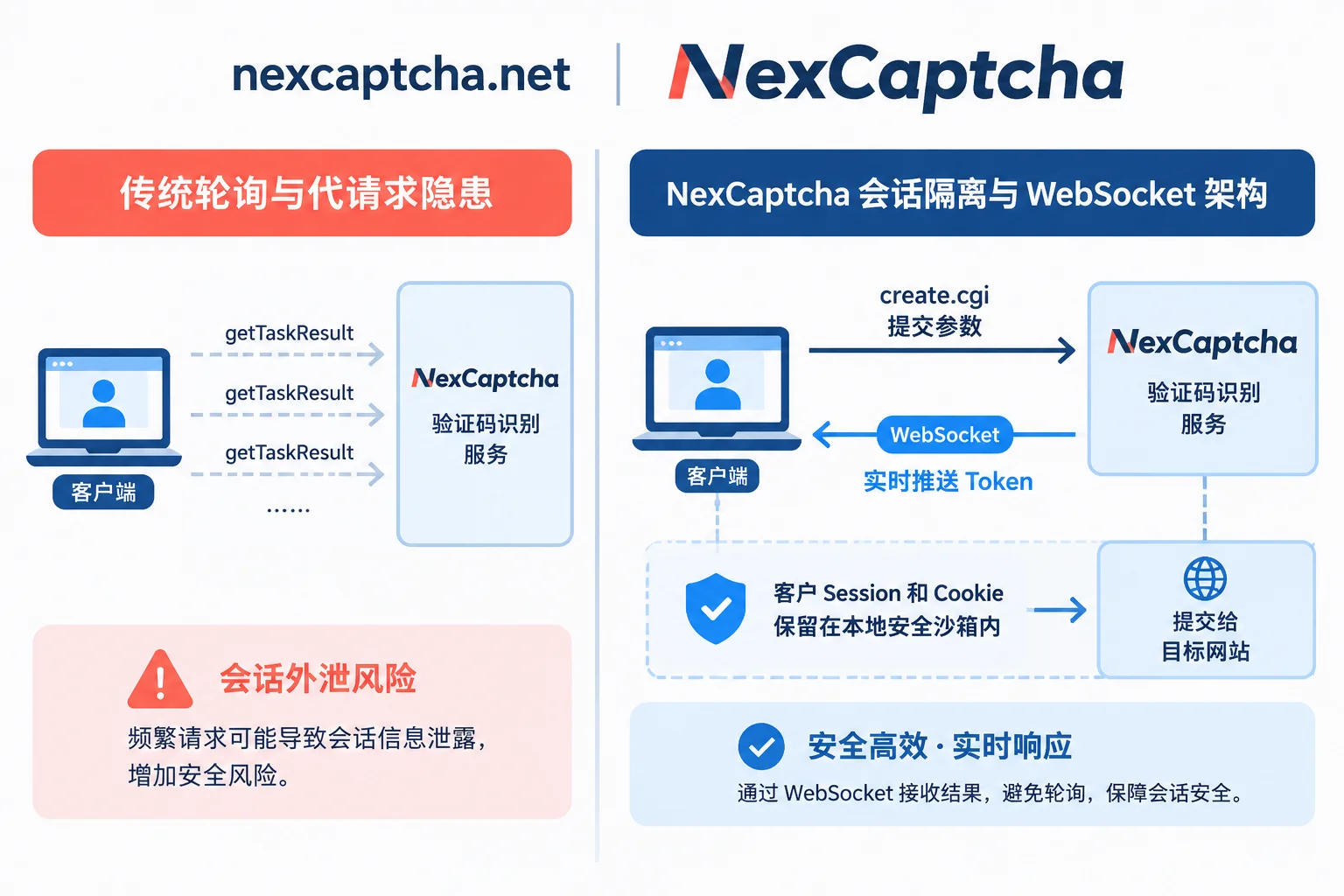
When obtaining recognition results, the traditional getTaskResult polling mode requires the client to continuously initiate HTTP requests; when concurrent tasks reach thousands, invalid "processing" polls consume a large amount of local connection pool resources. If the traditional Webhook (HTTP callback) mode is used, the client must have a publicly accessible fixed IP or configure complex intranet penetration and firewall whitelists, which is extremely unfriendly for scripts running on dynamic containers, CI/CD temporary nodes, or local development machines.
4. Integration gap in the AI Agent era
As teams begin to use Claude Code, Cursor, or self-developed AI Agents to write and execute automation tasks, traditional REST APIs require manually writing a large amount of glue code to encapsulate them as large model tools, lacking out-of-the-box standardized protocol support.
II. New Architecture Selection: Four Hard Metrics for Evaluating Alternatives
When comparing and testing 2Captcha alternatives, it is recommended that technical leads and procurement teams establish evaluation benchmarks around the following four core dimensions (can be combined with the accounting models in captcha platform cost comparison and how to calculate captcha API success rate):
| Evaluation Dimension | Pain Points of Traditional Crowdsourcing and Old Interfaces | Modern Automation Architecture Requirements (NexCaptcha as Example) |
|---|---|---|
| Coverage breadth and session security | Some new WAF challenges respond slowly; some proxy request solutions require hosted sessions | Covers reCAPTCHA v2/v3/Enterprise, Turnstile, Geetest v3/v4, DataDome, AWS WAF, Imperva, Tencent, NetEase, Alibaba Cloud, and other mainstream and general types; customers' own requests, sessions, and cookies do not pass through the server; only tokens, cookies, text, or coordinates are returned for customers to submit themselves |
| Result retrieval mechanism | Relies on high-frequency HTTP polling or Webhooks requiring public port exposure | In addition to query.cgi queries, natively provides WebSocket result push; clients actively establish connections, enabling real-time completion notifications without a public IP |
| Migration and modification cost | Field naming varies; switching platforms requires rewriting all parameter extraction logic | API documentation marks common task type names; internal fields of adapter follow the createTask system syntax (e.g., websiteURL, websiteKey); only the request outer layer and authentication need to be rewritten |
| Billing and financial compliance | Single cross-border payment channel; cumbersome dispute handling for failed tasks | Pay-per-use; failed or expired tasks automatically refund to balance; no subscription fees or minimum consumption; balance never expires; supports Alipay, WeChat Pay, USDT, and corporate bank transfer |
III. Interface Mapping in Practice: What Needs to Change When Migrating from 2Captcha to NexCaptcha?
When evaluating migration workload, many developers worry most about "do I have to rewrite all the parameter extraction logic in my crawler or test scripts?"
First, it must be clarified: NexCaptcha's interface is not in createTask / getTaskResult format, so existing 2Captcha code cannot be migrated by simply replacing the domain name. At the same time, NexCaptcha currently does not provide a verified installable official SDK, nor does it use HTTP Webhook callbacks; instead, it interacts directly through standard HTTP interfaces and WebSocket push.
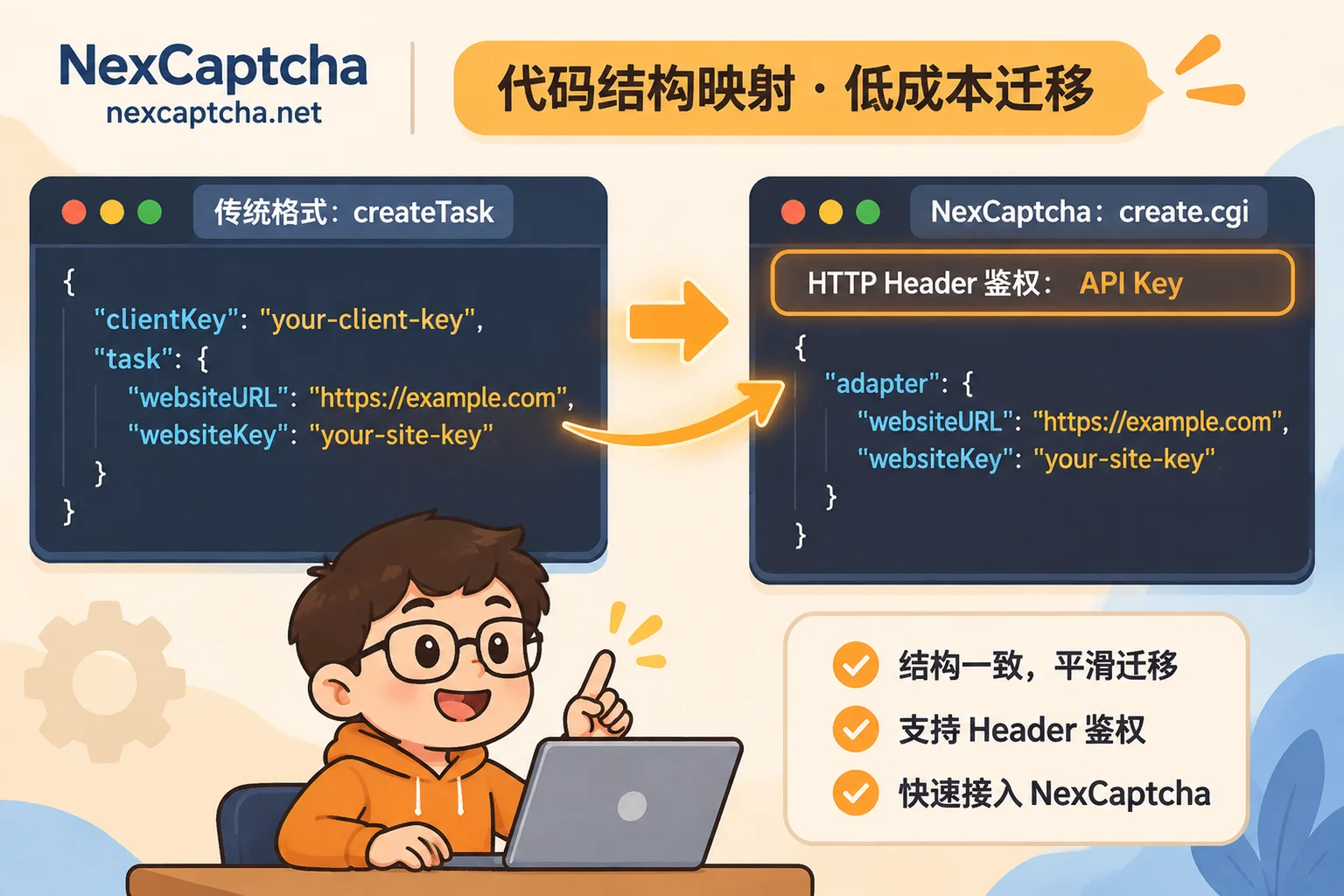
However, to minimize migration costs, NexCaptcha has implemented a clever layer of compatibility when designing its automated captcha interface: under each type's API documentation, the corresponding common task type name is clearly marked (e.g., RecaptchaV2TaskProxyless), and the core business fields in the request body adapter object directly follow the naming conventions of the createTask system (e.g., websiteURL, websiteKey).
This means your existing page parameter extraction code hardly needs to change; you only need to modify the request outer structure, authentication method, and result retrieval channel.
1. Request Outer Layer and Authentication Transformation Comparison
Taking the common no-proxy reCAPTCHA v2 (corresponding common name RecaptchaV2TaskProxyless) as an example:
- Original 2Captcha API v2 syntax: Place
clientKeyinside the JSON request body, distinguish types viatask.type, and send to/createTask. - NexCaptcha syntax: Place the API Key in the HTTP request header for authentication, with a unified endpoint
create.cgi; the outer layer selects the corresponding type via product code, while parameters such aswebsiteURL,websiteKeyoriginally intaskare placed unchanged into theadapterfield (for specific product codes and request header field names, refer to the API documentation).
# 架构改造示意:保留原有的参数提取字典,仅替换外层调度函数
captcha_params = {
    "websiteURL": "https://example.com/login",
    "websiteKey": "6Le-wvkSAAAAAPBMRTvw0Q4Muexq9bi0DJwx_mJ-"
}

# 迁移前(2Captcha v2 结构示意):
# payload = {"clientKey": "YOUR_KEY", "task": {"type": "RecaptchaV2TaskProxyless", **captcha_params}}

# 迁移后(NexCaptcha create.cgi 结构示意,具体编码以官方文档为准):
# API Key 移至请求头,业务参数直接塞入 adapter
headers = {
    "Content-Type": "application/json",
    "Authorization": "YOUR_NEXCAPTCHA_API_KEY" # 具体鉴权头格式请参考接口文档
}
payload = {
    "product_code": "RECAPTCHA_V2_PROXYLESS", # 按控制台产品目录编码填写
    "adapter": captcha_params                 # 沿用 websiteURL / websiteKey 等通行字段
}
Proxy handling is also very flexible: in NexCaptcha, some captcha types support optional customer-provided proxies, while some types require customer proxies; for tasks without a proxy, the system automatically uses the server-side proxy pool for recognition.
2. Replace High-Frequency Polling with WebSocket Push
After submitting a task and obtaining the task ID, NexCaptcha's task lifecycle has four clear states: processing, success, failure, expired. You have two ways to retrieve results:
- Query interface (
query.cgi): Suitable for low-frequency scripts or quick verification; logic is similar to pollinggetTaskResult. - WebSocket active push (recommended): For high-concurrency collection or latency-sensitive Python async httpx and Playwright integration scenarios, the client can directly establish a WebSocket connection. Once server-side recognition is complete, the result is immediately pushed to the client, eliminating the extra waiting latency caused by polling intervals and avoiding the need to configure public inbound routes locally like Webhook.
IV. Efficiency Features for AI Agents and Modern R&D Workflows
Beyond smooth replacement of basic interfaces, NexCaptcha also provides two highly practical capabilities for modern R&D team workflows:
1. Zero-code integration: Console online testing bench
When troubleshooting whether a new type of captcha (such as Geetest v4, DataDome, or custom click) can be recognized normally, developers previously had to read documentation and write complete request and polling code before testing. In NexCaptcha's console product catalog, each captcha type is equipped with an online testing bench. Technical leads only need to fill in their API Key and target page parameters to directly initiate a real task on the web page, intuitively verifying the returned data structure (token, cookie, text, or coordinates), and then schedule R&D integration after confirmation. If encountering special captcha types not yet covered in the list, they can directly send samples for a quote.
2. Native hosted MCP service: Let AI assistants directly call captcha capabilities
If your team is exploring making AI Agents work like humans or building automated inspection agents, NexCaptcha provides an out-of-the-box hosted MCP (Model Context Protocol) service:
- No local deployment: Hosted based on the Streamable HTTP standard; authentication only requires configuring an API Key. Configuration examples are provided for mainstream clients such as Claude Code, Claude Desktop, Cursor, Codex, VS Code, and Gemini CLI.
- Five standard tools: Built-in tools for querying products, querying parameter models, creating tasks, querying tasks, and querying balance. When an AI Agent encounters a captcha interception, it can autonomously query the parameter model and call the create task interface, and only task creation incurs charges; failed or expired tasks automatically refund to balance.
V. Four-Step Migration Plan for Reliable Deployment (with Pitfall Avoidance Guide)
To ensure business continuity in production, when switching existing traffic from 2Captcha to NexCaptcha, it is recommended to follow this four-step canary strategy:
- Inventory existing tasks and validate online baseline
Sort out the captcha types being called in the code (such as reCAPTCHA, Turnstile, slider, or image text). Go to the registration page to get an API Key (free test credits upon registration, no card binding required), first run a real sample on the console's online testing bench, and verify the returned token or coordinate format. - Encapsulate a unified Adapter scheduling layer
Abstract a unified interface layer in the project's captcha module. Leveraging the feature that NexCaptcha'sadapterfield follows thecreateTaskparameter syntax, reuse existing parameter extraction functions and only add a new request client forcreate.cgiand WebSocket /query.cgi. - Dual-run comparison by traffic ratio (Canary Release)
Do not hard-switch all production traffic at once. It is recommended to set traffic splitting weights via the configuration center (e.g., first switch 10%–20% of tasks to NexCaptcha), and compare end-to-end latency, final pass rate on target sites, and effective cost between the two sides under the same time window and target site. Since customers' own sessions, session data, and cookies remain entirely local and do not pass through the captcha server, dual-run splitting does not intrude on existing session pool management. - Full switch and exception fallback convergence
Once dual-run data is verified (focus on injection timing and proxy IP consistency in troubleshooting verification failures after token return), switch the main traffic entirely to the new channel. At the same time, because NexCaptcha adopts a transparent billing model with pay-per-use, non-expiring balance, and automatic tiered discounts when usage exceeds thresholds, teams can even retain dual channels as mutual disaster recovery without bearing any monthly subscription fees or minimum consumption burden.
Conclusion and Compliance Notice
Choosing a 2Captcha alternative is essentially an upgrade from "early manual crowdsourcing scripts" to "modern high-concurrency engineering architecture." By reusing the adapter parameter specifications of the createTask system, introducing WebSocket real-time push, and integrating the hosted MCP service, teams can achieve more stable automated testing, public data collection, and AI Agent execution experience with minimal code changes.
Compliance Statement: NexCaptcha only provides captcha recognition API technical services, specifically for compliant scenarios such as browser automation testing, AI Agents, RPA, accessibility assistance, and public data collection (SEO ranking, public price comparison monitoring). The platform strictly prohibits using the service for credential stuffing, account theft, bulk registration, sending spam, evading bans, payment fraud, bypassing paywalls or DRM, and other illegal or non-compliant purposes; upon discovery of violations, relevant keys will be immediately disabled without refund.
Ready to upgrade your captcha processing architecture? Register for free to get test credits now, browse the developer API documentation, or contact our technical team via Telegram online support to discuss migration plans.



