
In browser automation, public data collection (such as SEO ranking monitoring and e-commerce price comparison), and QA regression testing, Google reCAPTCHA is always an unavoidable hurdle for developers. If you find that your automated pipelines, which used to run stably, now frequently encounter 403 Forbidden or business-level "verification failed" when submitting a validly formatted token obtained through a reCAPTCHA recognition API to the target website's backend, this is often not because the CAPTCHA solving interface itself has failed, but because Google's underlying validation architecture has undergone a fundamental change.
As Google completed the forced migration of all reCAPTCHA Classic keys to Google Cloud projects (now integrated into the Cloud Fraud Defense system) from the end of 2025 to the beginning of 2026, the traditional simple validation logic of "v2 only needs image solving, v3 only looks at a single score" is rapidly fading. This article starts from the latest server-side validation mechanism and discusses how to use NexCaptcha CAPTCHA recognition API service to address the verification challenges in the fully enterprise era.
I. 2026 Architecture Evolution: When All Keys Enter Google Cloud
In the past, many development teams, when integrating reCAPTCHA recognition API, were accustomed to distinguishing v2 and v3 only by whether there was a checkbox on the page. But after Google completed the cloud migration, the industry faces three key technical facts:
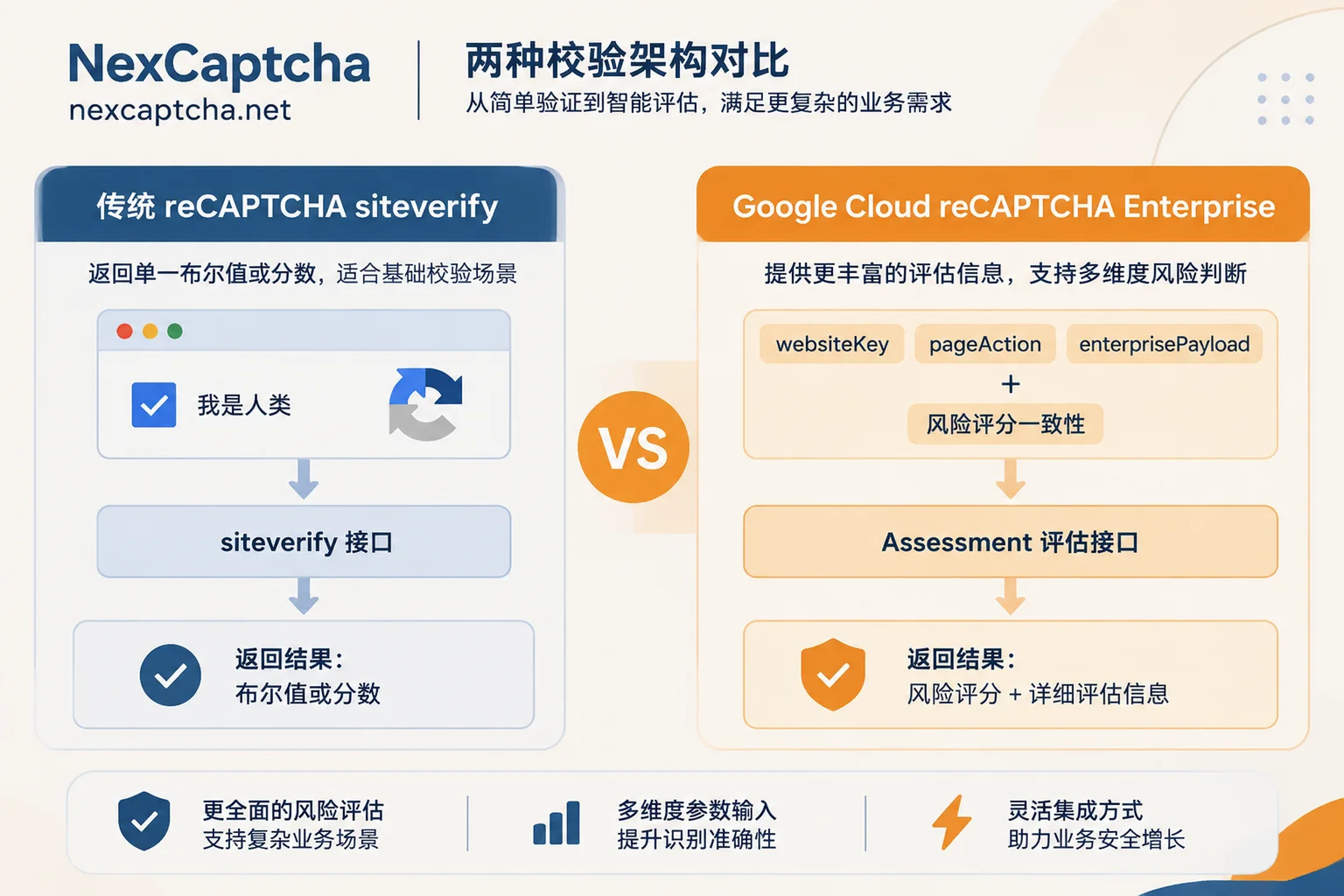
- Validation API evolves toward the Assessment model: The traditional free version mainly relies on the backend making a simple validation request to the
siteverifyendpoint; while under the Google Cloud system, more and more medium-to-large sites have switched to theprojects.assessments.createendpoint. What the backend receives is no longer just a simple boolean or an isolated0.1~0.9score, but a complete Assessment resource object containingtokenProperties(includingaction, hostname, timestamp) and detailed risk reason codes. - Blurring boundary between Classic and Enterprise: Even if the frontend page still loads code compatible with the old version, the key bound behind it has already belonged to a specific Google Cloud project. Many sites take this opportunity to directly upgrade the frontend script to
enterprise.jsand enable stricter behavioral context comparison. - Normalization of multi-defense hybrid scheduling: Because Google Cloud adjusted the free assessment quota, many sites, in order to control billing costs or enhance defense depth, start mixing Cloudflare Turnstile, Friendly Captcha, or AWS WAF at the entrance, and only retain reCAPTCHA Enterprise for core checkout and query interfaces.
For automation engineering teams, this means that when calling reCAPTCHA recognition API, the granularity of parameter extraction and the consistency of session context are raised to an unprecedented level.
II. Why Valid Token Format Still Gets Rejected? Breakdown of Three Core Issues
In production environments, evaluating the quality of a CAPTCHA solving interface can no longer be based solely on "whether the interface returns a string"; it must be based on "the final acceptance rate of the target site's server". When your request is intercepted by the target site's backend, it usually gets stuck in the following three stages:
1. Mismatch between Standard Flow and Enterprise Flow
Many developers hardcode RecaptchaV2TaskProxyless or standard RecaptchaV3TaskProxyless in their collection scripts. However, once the target site's frontend renders components via enterprise.js or calls grecaptcha.enterprise.execute(), the generated token signature structure differs from the standard version. Using a standard task type to solve an enterprise site, even if you get back a token, the target site's backend will directly throw a context invalid error when calling the Google Cloud Assessment API.
2. Missing pageAction and Dynamic Payload (Enterprise Payload)
In the reCAPTCHA v3 and Enterprise invisible scoring model, website owners bind action tags (e.g., login, search_price, submit_order) to specific actions in the frontend code.
- When you call the recognition API, if you do not pass the
pageActionparameter exactly as the frontend does, the interface usually uses a default value (e.g.,verify). - When the target site's backend receives the token and requests the assessment result from Google, it compares whether the
tokenProperties.actionin the returned JSON strictly equals the value expected by the current interface. Once mismatched, even if the token score is as high as0.9, the request will be discarded as fake traffic. - In addition, some high-defense enterprise sites inject encrypted
sparameters (i.e.,data-sorenterprisePayload) during initialization. Missing this parameter will cause the generated token to fail single-session validation.
3. Network and Session Disconnection in the Submission Chain
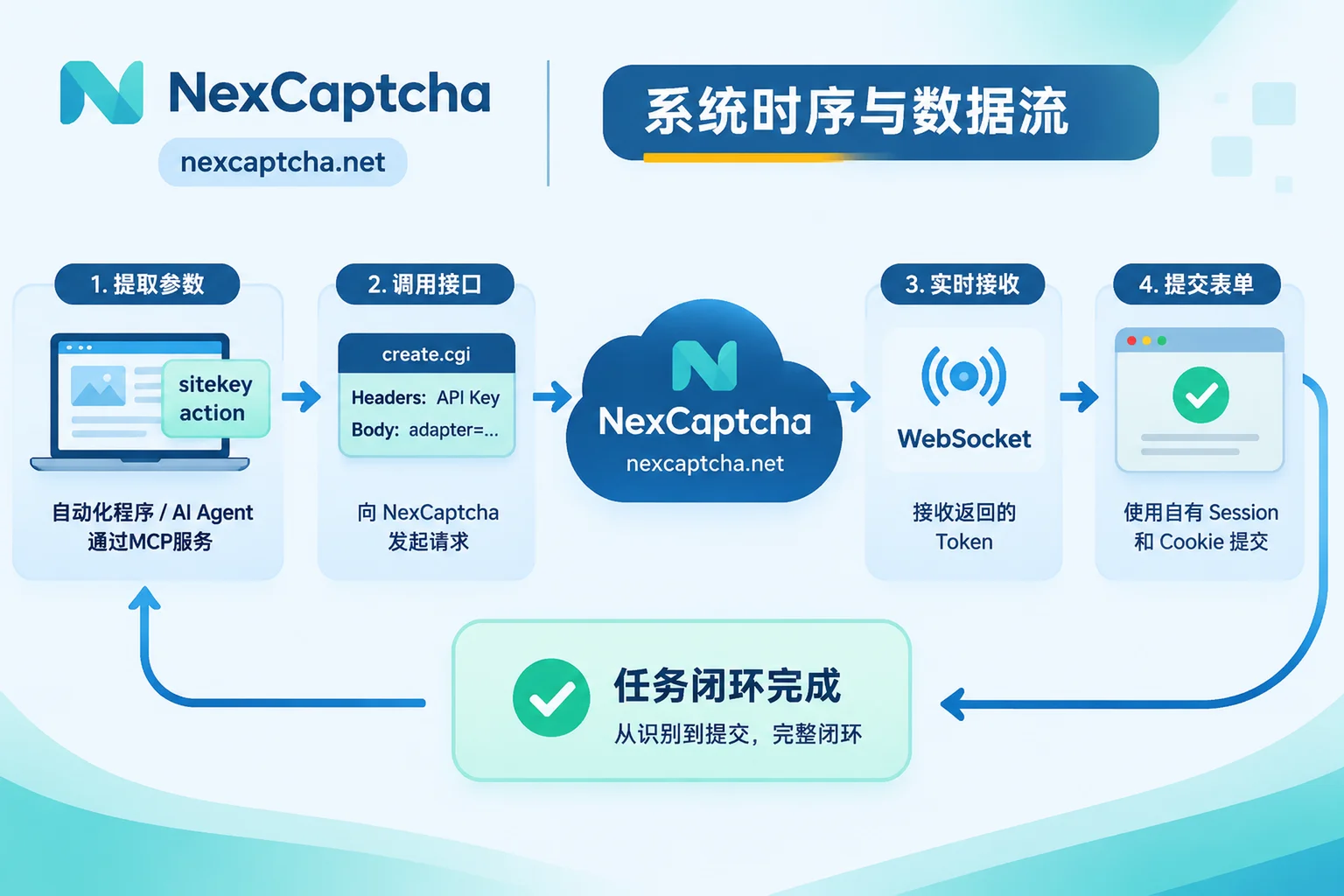
reCAPTCHA risk scores are not statically generated; they are strongly correlated with the request chain. Some types of CAPTCHA tasks support or require passing the customer's own proxy IP; meanwhile, the form submission action after obtaining the token must be completed by the customer using their own session (Session/Cookie) within the 2-minute validity period. If the timeout and retry mechanism is improperly designed and an expired token is submitted to the backend, it will not only trigger interception but also pollute the reputation of the current proxy IP.
III. NexCaptcha Engineering Solution: Precise Recognition, Asynchronous Push, and Unified Scheduling
Facing increasingly complex verification forms, NexCaptcha provides a CAPTCHA recognition API service designed for developers and enterprise teams, handling reCAPTCHA v2/v3/Enterprise (including invisible) and various mainstream CAPTCHAs through a unified interface, returning tokens for customers to submit in their own sessions.
1. Comprehensive reCAPTCHA Family Coverage and Online Test Bench
NexCaptcha supports the full range of types including reCAPTCHA v2, v3, and Enterprise (including Invisible mode), as well as Cloudflare Turnstile, Geetest v3/v4, FunCaptcha/Arkose, DataDome, AWS WAF, Imperva, and general types like image, slider, and click (full list available on the official supported types page or console product catalog).
To help developers quickly verify parameters before writing code, the NexCaptcha console provides an online test bench for each CAPTCHA type. Simply enter your API Key and the websiteURL, websiteKey, pageAction, or enterprise parameters extracted from the target webpage, and you can directly launch a real task on the page to intuitively confirm the validity of the parameter combination.
2. Session Isolation and Flexible Proxy Strategy
In terms of security and architectural boundaries, NexCaptcha adheres to the principle of "only recognition, no business session involvement":
- Fully autonomous sessions: Customers' own business requests, sessions, and cookies do not pass through NexCaptcha services. After the interface asynchronously returns the recognized token, cookie, text, or coordinates, the customer submits them with their own forms or interfaces.
- Flexible proxy configuration: For CAPTCHA types with different risk control levels, some types support optional passing of the customer's own proxy, while some IP-bound types require the customer's proxy; if not provided, the system defaults to using the server-side proxy pool for recognition.
3. create.cgi + WebSocket Push: Say Goodbye to Inefficient Polling
Traditional CAPTCHA solving platforms mostly use createTask plus high-frequency getTaskResult polling, which not only wastes network I/O in high-concurrency scenarios but also easily loses valuable token time-to-live (TTL) due to improper polling intervals.
NexCaptcha adopts a clear asynchronous architecture (see API documentation):
- Create task: Send a request to
create.cgi, authenticate with the API Key in the request header, specify the CAPTCHA type via product code, and fill in the parameters for that type in theadapterobject. - Get result: In addition to using
query.cgito query task status (which has four states: processing, success, failure, expired), it is strongly recommended to integrate WebSocket push in production environments (for specific encapsulation methods, refer to Python async httpx and WebSocket integration practice). Once recognition is complete, the server immediately pushes the result proactively, maximizing the valid time window of the token.
IV. Low-Cost Smooth Migration: Switching from Traditional Platforms to NexCaptcha
For technical leads conducting vendor evaluation and TCO cost accounting, the biggest concern when changing CAPTCHA solving platforms is often the regression risk caused by code changes. The architectural fact to note is: NexCaptcha's interface uses a create.cgi / query.cgi structure, not the createTask / getTaskResult format, so existing code from platforms like 2Captcha and Anti-Captcha cannot be migrated simply by replacing the domain.
However, to minimize modification costs, NexCaptcha has made high semantic alignment in its API design:
- Common naming reference: Under each product type in the OpenAPI documentation, the corresponding industry-standard
task typename is clearly indicated (e.g.,RecaptchaV2TaskProxyless,RecaptchaV3TaskProxyless, etc.). - Direct reuse of Adapter fields: The field names of the
adapterobject in the request body directly follow the familiarcreateTasksystem (e.g.,websiteURL,websiteKey,pageAction,minScore, etc.).
Recommended migration engineering practice:
When migrating from 2Captcha or Anti-Captcha, you only need to rewrite the outermost HTTP request routing, move the API Key to the request header, and adapt the status code parsing logic; the underlying parameter extraction code hardly needs to change. It is recommended to adopt a Canary Routing strategy in the initial launch: route 10%~20% of tasks to NexCaptcha, compare the first-packet latency, final pass rate of the target site, and effective billing consumption of both parties, and then switch over fully after the data is verified.
V. Empowering AI Agents: Directly Calling Recognition Capabilities via Hosted MCP Service
Entering 2026, more and more data collection and end-to-end testing tasks are being taken over by AI Agents based on large language models. As analyzed in Why Multimodal Vision (VLM) Cannot Handle Invisible Risk Control, facing shields like reCAPTCHA v3 or Enterprise that have no visual puzzle at all and rely purely on frontend JS environment fingerprints and behavioral scoring, visual large models relying on screenshot recognition are completely powerless.
To enable AI assistants to handle CAPTCHAs in a standardized way, NexCaptcha provides an out-of-the-box hosted MCP (Model Context Protocol) service:
- Zero local deployment: No need to spin up cumbersome middleware locally; directly connect via Streamable HTTP and authenticate with an API Key.
- Five atomic tools: Built-in five standard tools: query products, query parameter models, create task, query task, query balance. When an Agent encounters interception, it can first automatically query the parameter model required for the corresponding CAPTCHA, extract page features, and then create a recognition task.
- Ready-to-use with mainstream clients: The official page directly provides standard configuration examples for Claude Code, Claude Desktop, Cursor, Codex, VS Code, and Gemini CLI; other Agent frameworks supporting Streamable HTTP can also integrate seamlessly.
- Transparent and safe billing: Among the five MCP tools, only "create task" triggers billing; querying product catalogs, parameter models, task status, and account balance are completely free; and when a task fails recognition or times out, the system automatically refunds the cost to the balance.
VI. Billing Guidelines, Compliance Boundaries, and Quick Start
In terms of business model, NexCaptcha is committed to providing development teams with a predictable, no-hidden-tie-in billing experience (see pricing page for details):
- Pay-per-use, refund on failure: Strictly billed by successfully created tasks; failed or expired tasks automatically refund to balance;
- Zero-threshold long-term balance: No monthly subscription fee, no minimum consumption limit, account balance never expires, and tiered discounts are automatically triggered when usage crosses specified thresholds;
- Convenient payment and testing: Priced in USD, natively supports Alipay, WeChat Pay, USDT, and corporate transfer; new users register an account and receive test credits, and can start real integration testing without binding a credit card.
Compliance and Security Statement: NexCaptcha provides technical support specifically for legitimate browser automation, QA regression testing, AI Agents, and public commercial data collection (such as SEO monitoring and public price comparison; see industry solutions). The platform strictly prohibits using the API for credential stuffing, account theft, bulk registration, spam sending, ban evasion, payment fraud, or bypassing paywalls or DRM; once discovered, violating keys will be directly disabled without refund.
If your team is struggling with reCAPTCHA Enterprise low-score interception after the Google Cloud migration, or has encountered long-tail CAPTCHA types not listed, feel free to register to get an API Key and test on the console test bench, or send samples to communicate with our engineering team via the official Telegram customer service (@nextipkf) for inquiries and pricing.



