First, the conclusion: Based on public price lists, mainstream overseas CAPTCHA solving platforms generally price per 1,000 requests in USD. Simple image or character CAPTCHAs mostly range from $0.3–1 per 1,000, reCAPTCHA v2/v3 around $0.6–3 per 1,000, and Cloudflare Turnstile, GeeTest, AWS WAF, FunCaptcha, etc., mostly $1–3 per 1,000. Domestically, Chaojiying uses a credit system, with regular English-numeric image CAPTCHAs costing about 10–15 RMB per 1,000.
However, a twofold difference in unit price does not necessarily mean your actual bill will differ by the same factor. The final bill depends on three things: the billing metric the platform uses; whether the returned result is accepted by the target site; and how much extra proxy, browser session, and machine time retries and waiting consume. Below, we first unify the billing units, then provide public pricing references, and finally explain how to calculate the real cost for your own business.
Step 1: Align Billing Units First
Directly comparing price lists can be misleading because their "prices" may not use the same metric. Before comparing, confirm the following four points.
Currency and unit. 2Captcha, CapSolver, Anti-Captcha, and CapMonster Cloud use USD per 1,000. Chaojiying uses credits, typically at a base rate of 1 RMB = 1000 credits. Regular English-numeric image CAPTCHAs deduct 10–15 credits each, while complex types like Chinese characters or coordinate clicks deduct 20–30 credits each. To compare with USD quotes, convert to the same currency at the current exchange rate and ensure you are comparing the same CAPTCHA type.
Charge per request or per success? Some platforms only charge for validly generated results, while others depend on the specific type and failure reason. Here, "success" generally means the platform's own judgment—i.e., "a result was returned." This is not the same as "the target site accepted the result": when a token is rejected by the target site, the platform usually cannot know, and the fee is often still charged. For the billing formula and refund policy, see How CAPTCHA API per-thousand billing works.
Is the price dynamic? Some types on 2Captcha (e.g., reCAPTCHA v2) are publicly listed as a price range that varies with system load. Platforms with human involvement, like Anti-Captcha, may also have prices affected by worker pool supply and demand. Therefore, budget using a range, not the lowest price seen on a given day.
Deposit threshold and tiers. Third-party comparison articles mention that CapMonster Cloud typically has a minimum deposit starting at $6. Chaojiying offers bonuses and discounts at certain deposit levels. Small teams should factor in the threshold, while large teams should calculate based on the tier they will actually fall into.
Public Quotes by CAPTCHA Type
The table below is compiled from public pricing pages, documentation, and third-party comparison articles published in 2026. The unit is USD per 1,000 requests. It should only serve as a preliminary reference for selection; please refer to the current quote in each platform's console before ordering. "To be verified" means no reliable figure is available in existing sources.
| CAPTCHA Type | 2Captcha | CapSolver | Anti-Captcha | CapMonster Cloud |
|---|---|---|---|---|
| Regular image/character | 0.50–1.00 | ~0.40 | ~0.50 | 0.30–0.60 |
| reCAPTCHA v2 | 1.00–2.99 (varies with load) | ~0.80, Enterprise ~1.00 | ~1.00 | 0.60–0.90 |
| reCAPTCHA v3 | ~1.45–2.99 | ~1.00, Enterprise ~3.00 | ~2.00 | 0.60–0.90 |
| Cloudflare Turnstile | ~1.45 | ~1.20 | 2.00–2.99 | 1.20–1.30 |
| GeeTest v3/v4 | ~1.45–2.99 | ~1.20 | To be verified | To be verified |
| AWS WAF | To be verified | ~2.00 | To be verified | To be verified |
Two patterns emerge from the table:
- Within the same platform, prices for different types can differ several times over. If your business has a high proportion of reCAPTCHA v3 Enterprise or AWS WAF, budgeting based on the "lowest image CAPTCHA price" will severely underestimate costs.
- reCAPTCHA v2, v3, and Enterprise must be compared separately. v3 returns a token with a score, and target sites often use thresholds like 0.7 or 0.9 to decide whether to allow access. A cheap token with a low score may require multiple retries before it is usable. For the mechanism differences, see Difference between reCAPTCHA v2 and v3.
Also note that the Turnstile widget and the full-page Cloudflare Challenge are different tasks with different pricing and difficulty, so they cannot be estimated with the same price.
The Number That Really Matters: Cost per Successful Business Action
The figure on the price list is only part of the input. A metric closer to the real bill is "cost per accepted business action," which can be roughly calculated as:
Cost per successful action ≈ Unit price × Number of recognitions per successful action + Proxy/session cost per attempt × Number of attempts
Here, "number of recognitions per successful action" is approximately 1 ÷ target site acceptance rate. The lower the acceptance rate, the more retries, and the more easily the unit price advantage is offset.
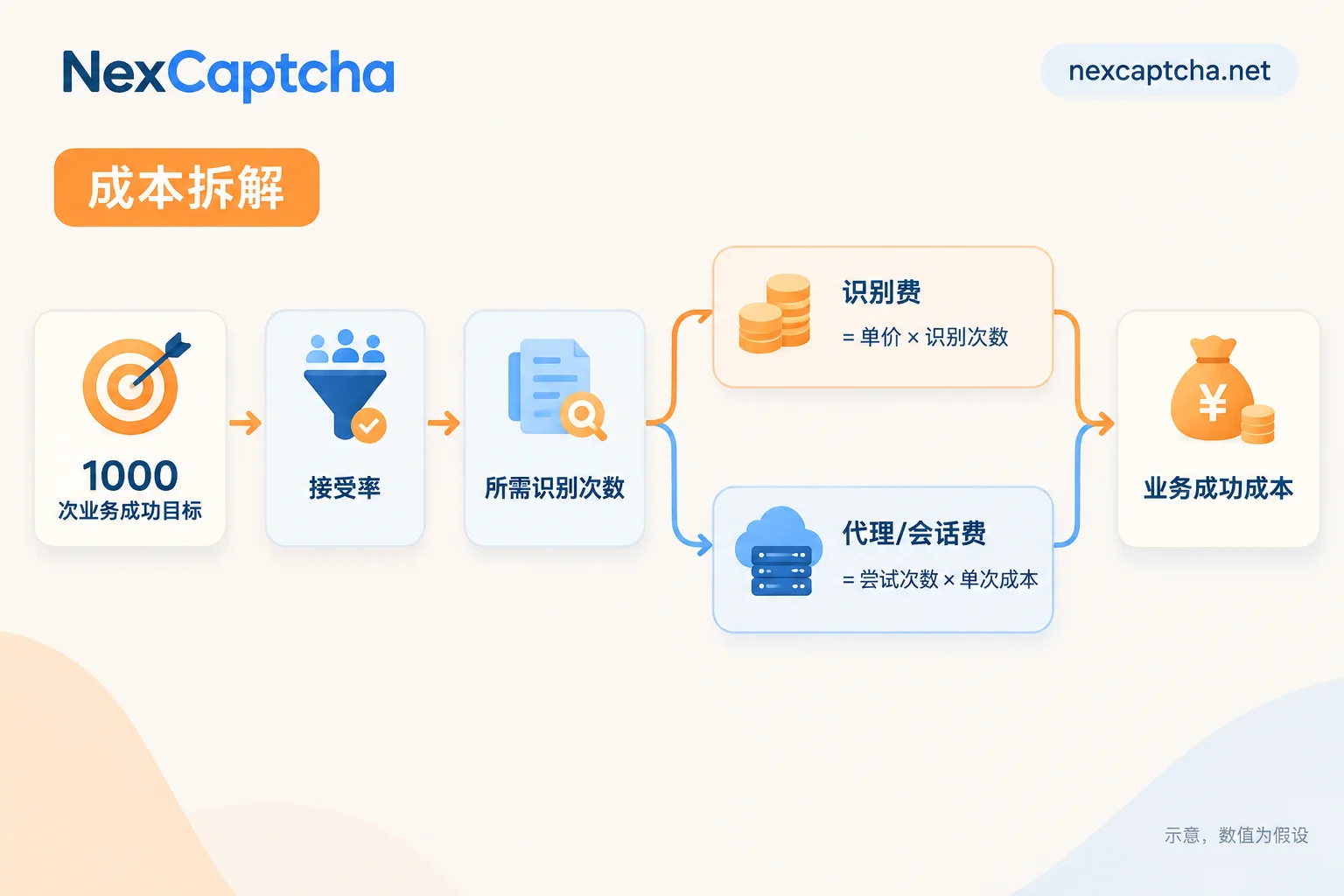
Example (all numbers are hypothetical, not actual measurements from any platform): Suppose you need to complete 1,000 submissions accepted by the target site, and each attempt costs $0.0005 in proxy and session fees.
- Platform A: Unit price $0.80 per 1,000, acceptance rate 70%. Needs about 1,429 recognitions. Recognition fee ~$1.14, proxy/session fee ~$0.71, total about **$1.86**.
- Platform B: Unit price $1.20 per 1,000, acceptance rate 95%. Needs about 1,053 recognitions. Recognition fee ~$1.26, proxy/session fee ~$0.53, total about **$1.79**.
Under these assumptions, Platform B, which is 50% more expensive on the price list, actually has a slightly lower total cost. The more expensive the proxy is (whether billed by traffic or time), the more pronounced the impact of acceptance rate. Conversely, if both platforms have similar acceptance rates, the cheaper one will indeed save money. Therefore, this conclusion only holds for your own data and cannot be generalized to others.
Latency Also Turns into Money
Recognition time is not on the price list, but it shows up on other bills. Pure AI recognition typically returns within seconds. Third-party reviews mention that platforms with a high proportion of human involvement often have 8–30 second waits for complex types. During the wait, browser instances, proxy IPs, and sessions are occupied; if the wait is too long, the token may expire or the page session may change, causing previous costs to be wasted.
When evaluating latency, look at P50 and P95 separately, not just the average. P95 determines how long your timeout threshold should be and how much concurrency margin to reserve. For how to stop losses after a timeout, see How to handle CAPTCHA API timeouts.
Use Small-Scale A/B Testing Instead of Comparing Price Lists
Price lists, third-party rankings, and self-reported success rates cannot replace data from your own scenario. It is recommended to conduct a parallel comparison in your own or authorized environment, or in public data tasks where collection is permitted:
- Fix variables: Same CAPTCHA type, same target page, same proxy pool, same time period. Alternate tasks between platforms to avoid one running during the day and another at night.
- Sufficient sample size: Run at least a few hundred tasks per platform per type; otherwise, fluctuations in acceptance rate will mask differences between platforms.
- Record five numbers: Number of submissions, number of results returned by the platform, number of acceptances by the target site, P50/P95 latency, and actual charged amount. Use the platform's billing as the source for charges, not "unit price × count."
- Distinguish failure causes: A rejected token is not necessarily the platform's fault; incorrect parameter extraction, wrong injection timing, and poor IP reputation can all cause failures. For troubleshooting order, see How to troubleshoot CAPTCHA token verification failures after return.
- Include integration and maintenance costs: SDK modifications, task field differences, error code mapping, and callback changes all require engineering time. When monthly call volume is low, this part may cost more than the recognition fees.
After testing, use the formula above to calculate the cost per successful business action for each platform, then decide based on type coverage and support responsiveness.
What to Confirm When Including NexCaptcha in the Comparison
If you plan to include NexCaptcha in this comparison, here is what its official homepage states (self-reported by the site, not independent test conclusions):
- It handles reCAPTCHA v2/v3/Enterprise, hCaptcha, Cloudflare Turnstile/Challenge, GeeTest v3/v4, FunCaptcha/Arkose, AWS WAF, and various image, slider, and click CAPTCHAs through a unified REST task interface. The homepage lists 33 pricing types.
- It bills per thousand successful recognitions, supports refunds for failures and tiered volume discounts, and offers test credits.
- It claims compatibility with some task formats of 2Captcha, Anti-Captcha, CapSolver, and CapMonster, which can reduce integration effort for parallel testing.
Note that the unit price for each type, which failure scenarios are covered by refunds, and whether your task types fall within the compatible range all need to be confirmed item by item. Compatibility is established per task type; it does not mean you can switch by just changing the domain. Fields, type name casing, callbacks, and error codes must all be checked against each other. For a migration checklist, see How to choose a 2Captcha alternative and How to choose a CapSolver alternative.
When you are ready to start comparison testing, you can visit the NexCaptcha official homepage to view pricing for each CAPTCHA type, migration instructions, and contact information for engineers. After running samples under the same conditions with test credits, make a decision based on cost per successful business action.