
In modern software delivery systems, "shifting quality right" and full-link automated regression have become standard practices for engineering teams. In the past, when QA teams performed UI automation or API regression, encountering CAPTCHAs was often solved by simply "asking developers to disable or whitelist in the test environment." However, when test scenarios extend to staging environment integration, production synthetic monitoring (Synthetic Monitoring / online inspection), and cross-border multi-end integration testing, traditional "backdoor" solutions completely fail.
Production environments, due to security and compliance requirements, will never enable universal CAPTCHAs. Meanwhile, gateway-level Cloudflare Turnstile, reCAPTCHA Enterprise, or business-level GeeTest, slider, and click CAPTCHAs directly block nightly CI/CD pipelines and scheduled probing tasks. How to upgrade automated test CAPTCHA handling from "temporary script modification manual work" to "high cohesion, observable, cross-environment reusable foundational components" is an architectural challenge that SDETs and QA leads must address.
This article steps away from the syntax details of a single test framework and, from the perspective of test infrastructure, deconstructs a CAPTCHA handling solution that balances execution speed, security compliance, and maintenance cost.
I. Why Can't Traditional "Blocking and Whitelisting" Support Modern QA Systems?
In many teams' continuous integration pipelines, UI regression testing often consumes over 40% of build time, and "flaky tests" caused by CAPTCHAs and risk control interceptions are the number one culprit slowing down delivery. Traditional bypass solutions directly fail in the following three high-frequency scenarios:
- Production Smoke Test
To detect gateway configuration omissions, CDN cache anomalies, or third-party service failures before real users report errors, core links (login, coupon claiming, order placement, form submission) must be executed in production with 7×24 scheduled inspections. Planting test whitelists or retaining universal CAPTCHAs in the production database is a serious security red line vulnerability. - Third-Party Integration and Sandbox Integration
When business processes depend on external payment gateways, cross-border logistics queries, public SEO/price data verification, or OAuth authorization pages, the frontend and risk control of the system under test belong to external teams, and your own developers have no authority to disable CAPTCHAs on their pages. - Risk Control Verification and Frontend SDK Integration Itself
If CAPTCHAs are always disabled in the test environment, then when the frontend upgrades the CAPTCHA SDK, modifies callback parameters, adjusts popup DOM hierarchy, or the gateway modifies secondary signature verification logic, defects will directly leak to production. End-to-end (E2E) closed-loop testing of real CAPTCHAs is itself part of regression testing.
If your team is writing scripts using a specific framework, you can first refer to our previous practical guides for single frameworks: How to do Playwright CAPTCHA testing and How to do Selenium CAPTCHA testing. In team-level collaboration across multiple projects and environments, we first need to establish standards for layered routing.
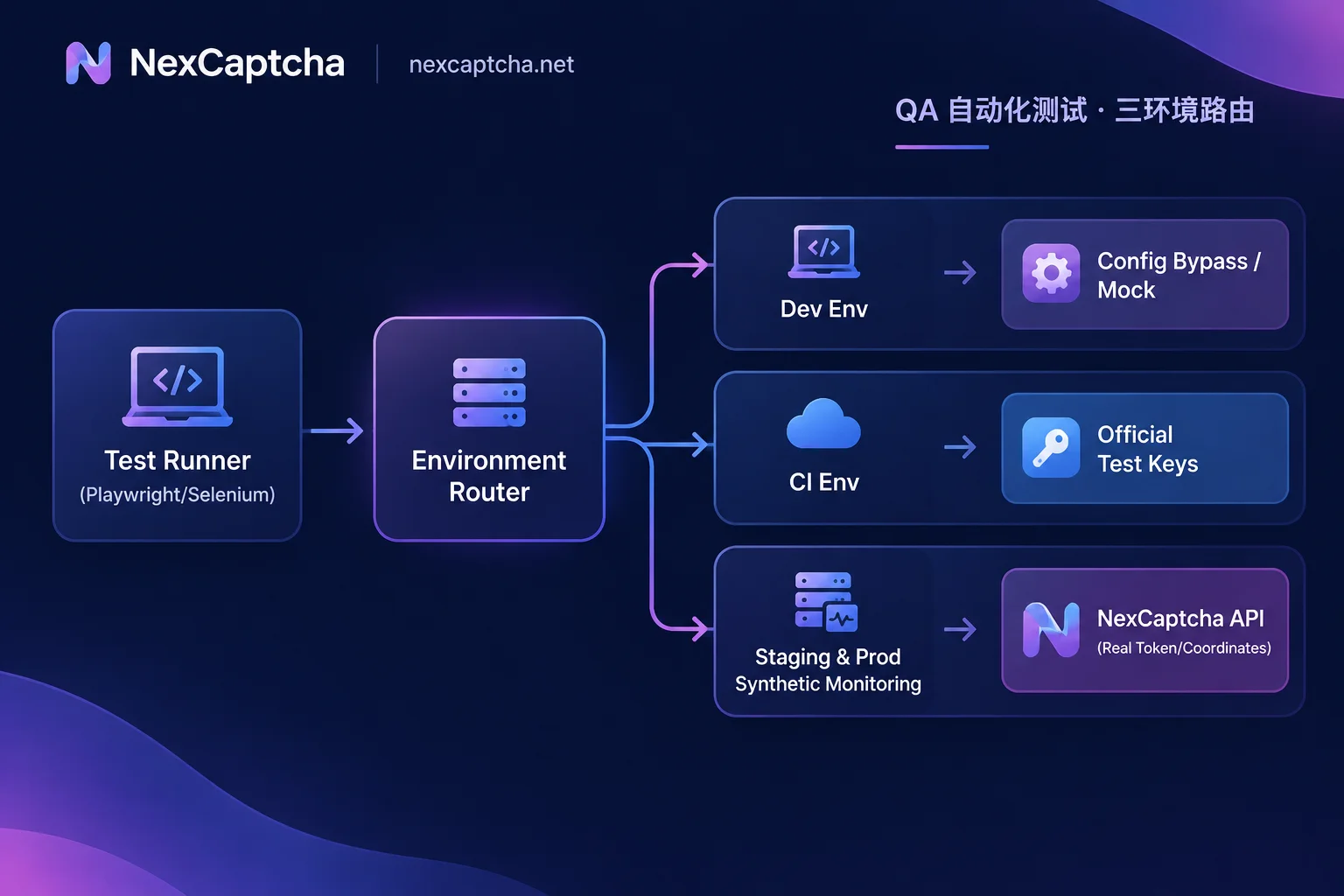
II. Environment-Driven Three-Tier Routing Strategy: One Codebase Runs the Full Link
Excellent test engineering strictly prohibits the chaos of "one set of code locally, one set in CI, and another modified set for online inspection." In architectural design, the handling routing of CAPTCHAs should be uniformly controlled in the test foundation through environment variables (such as TEST_ENV and CAPTCHA_STRATEGY):
| Environment Tier | Typical Test Objectives | Recommended CAPTCHA Handling Strategy | Speed and Cost Performance |
|---|---|---|---|
| Dev / Local and Unit Test Environment | High-frequency verification of business logic, component interaction, and boundary values | Internal configuration blocking / Mock injection: Disable verification through test-specific headers or configuration center | 0 latency, 0 external call cost |
| CIT / Continuous Integration Environment | Verify frontend-backend API contracts and SDK rendering callback logic | Official Test Keys: Use reCAPTCHA or Turnstile official always-pass/always-fail test Sitekeys | Millisecond response, verify frontend mounting and callback flow |
| Staging & Prod / Staging and Production Inspection | Verify real risk control configuration, gateway policies, and core business availability | Real recognition API integration: Call NexCaptcha CAPTCHA recognition API to obtain real Token or coordinates | 100% restore real user flow, pay-per-use |
Through this three-tier model, 80% of high-frequency ordinary functional test cases are quickly digested in the lower environment; while in the most critical staging checkpoints and production inspections, the test framework automatically switches to the real recognition channel, both safeguarding the security bottom line and ensuring the authenticity of full-link online monitoring.
III. Architecture Design: Building a Decoupled CaptchaSolver Unified Middleware
In the product matrix of a medium-to-large enterprise, multiple CAPTCHAs often coexist: overseas sites use Cloudflare Turnstile or reCAPTCHA v2/v3, domestic marketing campaign pages use GeeTest v4 slider or click, and legacy internal backends still use traditional image character CAPTCHAs.
If the parsing logic for different CAPTCHAs is hardcoded in each Page Object, the test code will quickly become an unmaintainable quagmire. The correct design is to abstract a unified CAPTCHA handling middleware at the bottom layer of the test framework.
1. Unified Interface Protocol and Adapter Pattern
The interface design of NexCaptcha naturally fits the plugin requirements of test frameworks. Its underlying layer adopts a unified asynchronous task mechanism: create recognition tasks via create.cgi, query results via query.cgi (API Key placed in request header for authentication). Regardless of the CAPTCHA type on the page, the outer request structure is completely identical; you only need to select the type by product code and fill in the parameters for the corresponding type in the adapter field.
Currently, this interface covers reCAPTCHA v2/v3/Enterprise (including invisible), Cloudflare Turnstile, GeeTest v3/v4, FunCaptcha/Arkose, DataDome, AWS WAF, Tencent, NetEase Yidun, Alibaba Cloud as well as various general image, slider, click, and rotate CAPTCHAs. If you encounter special self-developed CAPTCHAs, you can also directly submit samples for custom pricing.
2. Session Isolation Ensures Test Validity
In automated testing, a highly insidious pitfall is "who initiated the request." When test scripts verify login or order placement, the browser context holds specific Cookies, LocalStorage, TLS fingerprints, and egress IPs.
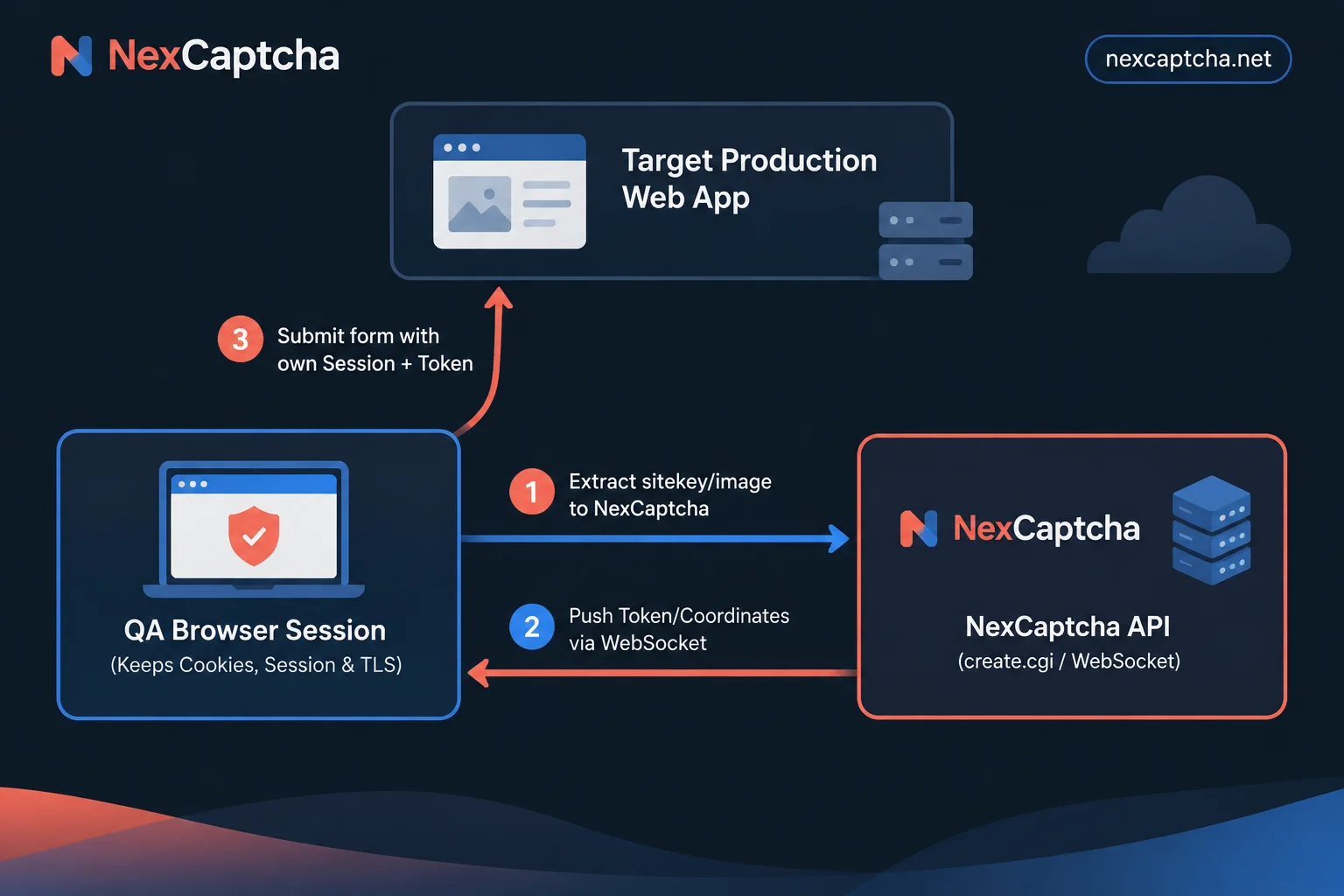
NexCaptcha adopts a pure recognition and session separation architecture:
- Test scripts extract necessary public parameters from the current page (such as
websiteURL,websiteKey, dynamicchallenge, or screenshot Base64) and pass them to the API; - Requests, Sessions, and Cookies of the system under test do not pass through the CAPTCHA solving server at all;
- The API asynchronously returns the recognized Token, Cookie, text, or click coordinates (such as slider offset, click coordinate sequence);
- After obtaining the result, the test script completes DOM filling in its own browser session, triggers frontend Callback (see Cloudflare Turnstile Recognition API Integration Guide and GeeTest CAPTCHA Recognition in Practice), and submits the form.
For high-security CAPTCHAs that verify request IP consistency, the API supports passing the test machine's own proxy configuration; if the target type has no mandatory binding requirement and no proxy is passed, it automatically uses the server's built-in proxy pool to complete recognition. If after filling you encounter verification failure on the target site, you can refer to How to troubleshoot verification failure after CAPTCHA token returns to check parameters and injection timing one by one.
3. Replace High-Frequency Polling with WebSocket Push to Reduce CI Time
In CI/CD pipelines, every extra 5 seconds waited per test case adds up to tens of minutes of blocking across hundreds of cases. Traditional sleep + HTTP 轮询 not only wastes network overhead of the test runner but also increases end-to-end latency due to improper polling interval settings.
In addition to conventional query.cgi polling, NexCaptcha natively supports WebSocket result push (for underlying comparison of the two modes, see What is the difference between CAPTCHA API polling and callback). Establish a long connection during test framework initialization; when the task status changes from "processing" to "success", "failure", or "expired", the server proactively pushes to the test runner within milliseconds, significantly shortening the wait cycle of a single regression case.
IV. 2026 Frontier Practice: Integrating Managed MCP into AI-Driven Test Workflows
Entering 2026, more and more QA teams are introducing AI coding assistants (such as Claude Code, Cursor, VS Code Copilot, Windsurf, or Gemini CLI) to assist in writing automated test scripts, recording locators, and autonomously executing exploratory testing (AI Agent Testing).
When an AI assistant debugs a production inspection script locally or in a sandbox, or encounters a CAPTCHA during autonomous inspection tasks, there is no need to manually write complex HTTP glue code. NexCaptcha provides an out-of-the-box Managed MCP (Model Context Protocol) Service:
- Zero local deployment: Connect directly via Streamable HTTP protocol, authenticate with your API Key; the configuration page has built-in copy-paste configurations for mainstream clients such as Claude Code, Claude Desktop, Cursor, Codex, VS Code, Gemini CLI.
- Five atomic tools closed loop: Built-in five standard tools: query product catalog, query parameter model, create task, query task, query balance. When an AI Agent encounters CAPTCHA interception, it can autonomously call tools to query the
adapterparameter specification required for that type, create a recognition task, and retrieve the Token to continue executing subsequent assertions. - Risk control and anti-infinite loop: Billing is triggered only when calling "create task"; query tools are completely free. Combined with the maximum retry circuit breaker design introduced in our How to handle CAPTCHAs when AI Agent encounters them, it effectively prevents AI from infinitely looping and consuming credits on abnormal pages.
V. Engineering Implementation Checklist: Fault Tolerance, Cost Accounting, and Low-Risk Migration
Before formally incorporating the CAPTCHA recognition API into enterprise QA infrastructure, technical leads and procurement usually also need to evaluate stability fallback, financial compliance, and migration costs:
- Clarify State Machine and Timeout Stop-Loss
When writing Retry decorators for test frameworks, it is essential to strictly distinguish the task states returned by NexCaptcha (processing, success, failure, expired). When the state is clearly "failure" or "expired", the system automatically refunds the cost to the account balance; at this time, the test framework should refresh the CAPTCHA component and re-extract dynamic parameters instead of waiting with the old serial number (for troubleshooting ideas, see What to do if CAPTCHA task stays processing). - Pricing Model Fitting QA Traffic Characteristics
Automated testing traffic has obvious "peak and valley" characteristics—concurrent concentration before release and nightly full regression, while maintaining only low-frequency inspection at ordinary times. NexCaptcha adopts a pay-per-use, balance never expires, no monthly subscription fee or minimum consumption limit mechanism; failed or expired tasks are automatically refunded; usage automatically enjoys discounts after reaching tiered thresholds. Financial settlement supports Alipay, WeChat, USDT, and corporate bank transfer (see Official Pricing). - Use Online Test Bench for Prior Verification
Before writing any integration code, QA engineers can log into the Console Product Catalog. Each CAPTCHA type is equipped with a visual online test bench; fill in your API Key and test parameters of the target page to immediately initiate a real recognition task and intuitively verify the returned data structure and latency. - Smooth Migration of Existing Test Projects
If the team previously integrated early platforms like 2Captcha or Anti-Captcha in test scripts, migrating to NexCaptcha is very straightforward: the Open API Documentation under each type annotates the industry-standard task type names (e.g.,RecaptchaV2TaskProxyless), and the internal fields ofadapterfollow familiar naming conventions such aswebsiteURL,websiteKey. You only need to rewrite the outer request routing (create.cgi/query.cgi) and request header authentication logic, and after dual-run verification in CI according to traffic ratio, you can fully switch.
Compliance Notice: NexCaptcha strictly serves legitimate scenarios such as automated testing, QA regression, AI Agent authorized operations, and public data collection (for more industry solutions, see Solutions Page). It is strictly prohibited to use the API for credential stuffing, bulk malicious registration, bypassing paywalls, or payment fraud; keys that trigger compliance red lines will be directly disabled.
Conclusion
In today's increasingly fast continuous delivery pace, CAPTCHAs should not become a "blind spot" hindering staging verification and production environment inspection, nor should they force development teams to leave dangerous backdoor switches in production code. Through the architectural design of environment-tiered routing + unified Adapter encapsulation + session isolation filling, combined with NexCaptcha's stable recognition API and managed MCP capabilities, QA teams can build a truly end-to-end automated quality defense line with extremely low maintenance cost.
Now you can go to register a free account and get an API Key (no card binding required, test credits given upon registration), or run your first automated regression case on the console online test bench. For custom test concurrency solutions or inquiries about special CAPTCHA types, feel free to contact Telegram online support.



