
When building browser automation, QA regression testing, public data collection (such as SEO ranking tracking, e-commerce price comparison, and price monitoring), and AI Agent workflows, CAPTCHAs are often the critical node that determines pipeline stability.
With the development of the open-source ecosystem and multimodal technologies, technical leads and developers often face a classic question when making architectural decisions: Should we build our own recognition service with open-source models, directly call visual large models, or integrate a professional third-party CAPTCHA solving service?
Many teams try to "go it alone" in the early stages of a project, but after business scaling or upgrades in target site protection, they have to refactor code and switch back to professional interfaces. This article examines the technical boundaries and hidden costs of these three approaches from an engineering implementation perspective, and provides evaluation criteria and integration solutions for enterprise-grade CAPTCHA solving services.
1. Real Costs and Capability Boundaries of Three Main Approaches
In the early stages of a project, technical teams tend to focus only on the "visible cost per call" while ignoring hidden costs brought by R&D investment, compute maintenance, and anti-bot confrontation. We can compare mainstream solutions in three tiers:
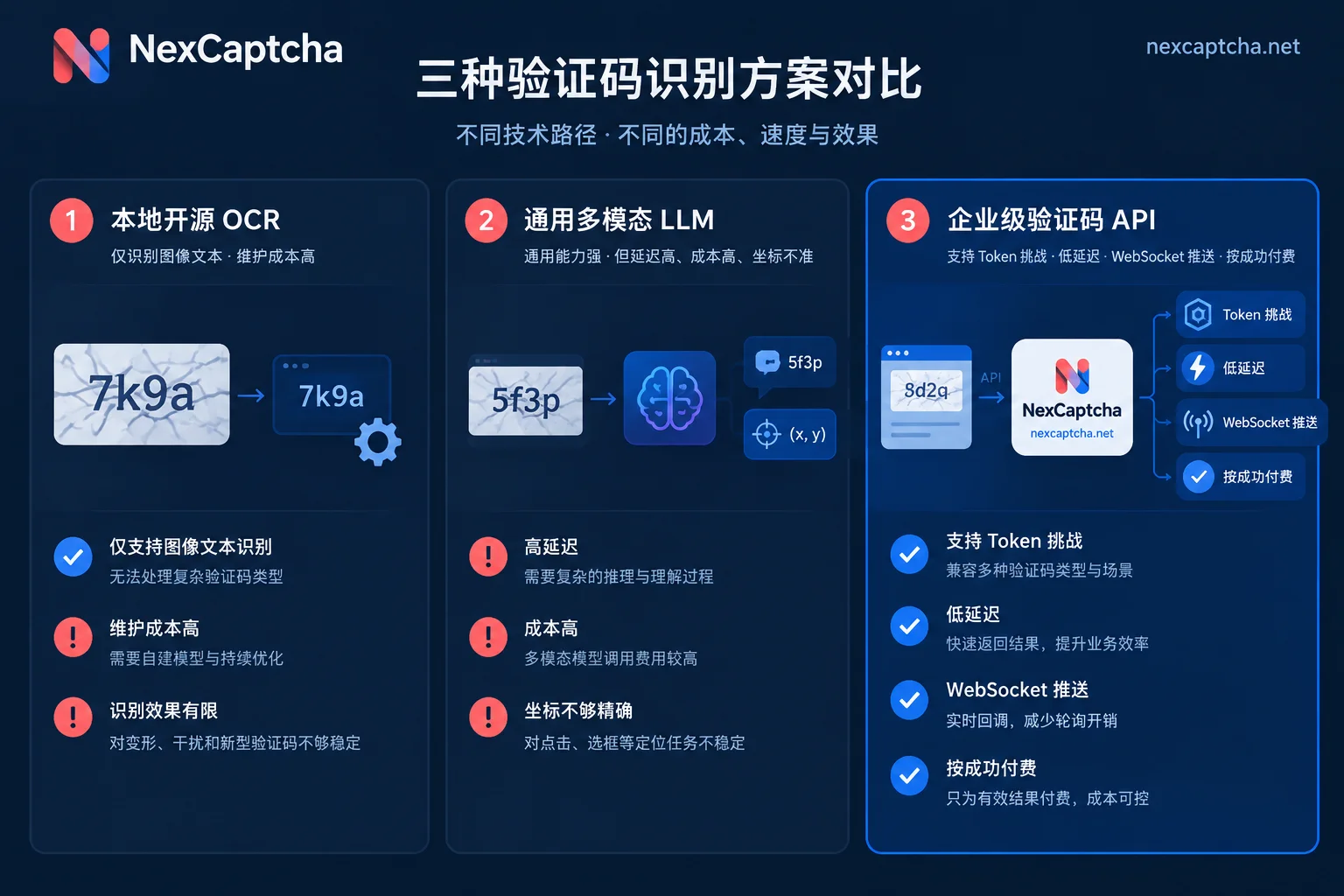
1. Local Open-Source OCR and Self-Trained Models (e.g., ddddocr, custom YOLO/CNN)
Many developers are accustomed to deploying lightweight open-source libraries based on ONNX locally (such as ddddocr), or training object detection models themselves using deep learning frameworks.
- Applicable scenarios: Simple static character images without anti-bot linkage, simple arithmetic problems with fixed fonts, or slider gaps with fixed layouts.
Engineering bottlenecks:
- High cost of adversarial iteration: Once the target site changes fonts, adds dynamic interference lines, or adjusts click-selection corpora, the accuracy of local models drops sharply, requiring re-collection of samples, labeling, and training.
- Unable to handle Token-based verification: Modern mainstream protections (such as reCAPTCHA, Cloudflare Turnstile, GeeTest v4, FunCaptcha) focus on front-end environment fingerprints, encrypted parameter validation, and back-end risk scoring. They return an encrypted
tokenrather than image text, so pure visual OCR completely fails in such scenarios.
2. General Multimodal Large Model (VLM) Calls
With the proliferation of visual large models (such as GPT-4o), some teams attempt to directly send webpage screenshots to large model APIs and use prompts to make the model return text or click coordinates.
- Applicable scenarios: Low-frequency exploratory testing, image-text click selection that is extremely niche in layout but relies entirely on visual semantics.
Engineering bottlenecks:
- Latency and unit price inversion: Multimodal large models usually take several seconds to process high-resolution screenshots, and the cost billed by image tokens is much higher than dedicated recognition services. For details on cost accounting, refer to our previous article "CAPTCHA Solving Service Cost Comparison: Public Pricing, Billing Calibers, and Real Cost Algorithms of Mainstream Platforms".
- Insufficient coordinate precision: Large models excel at understanding semantics, but often drift in pixel-level coordinate positioning (such as accurately returning puzzle offsets or center pixels of continuous click selections), and they also cannot directly generate the verification Token required by security protection systems.
3. Professional CAPTCHA Solving Platform APIs
Professional CAPTCHA recognition API services encapsulate "visual image recognition" and "protocol-level Token challenge handling" into a unified asynchronous interface. Developers only need to pass in the page URL, sitekey, or image parameters by type, and receive back token, cookie, text, or coordinates.
- Core advantages: Eliminates GPU compute maintenance and algorithm reverse engineering, charges per use, and covers the full range from traditional graphics to enterprise-level behavioral verification.
2. Why Do Professional CAPTCHA Solving Services Become Essential Under Modern Anti-Scraping Systems?
If the business only involves static graphic codes from internal legacy systems, local OCR is fully sufficient. However, in real public data collection, cross-border e-commerce price monitoring, or automated regression testing, the protection landscape has undergone a fundamental shift.
1. From "Reading Images" to "Frictionless Risk Control and Token Interaction"
Nowadays, many websites have abandoned traditional distorted character images and instead deploy protections such as Cloudflare Turnstile, reCAPTCHA v2/v3/Enterprise, GeeTest v3/v4, DataDome, AWS WAF, and Imperva. Such verification not only examines interaction results but is also deeply bound to TLS fingerprints, browser environments, and IP reputation.
If you are upgrading from traditional screenshot-based CAPTCHA solving to a modern architecture, we recommend reading "How to Choose a Super Eagle Alternative: Architecture Evolution and Migration Practice from Screenshot Upload to Token Direct Solving" to understand the essential differences in integration logic between the two generations of technology.
2. Fragmented Types and Long-Tail Maintenance Challenges
In cross-site collection or general AI Agent browsing tasks, the types of CAPTCHAs the program faces are highly uncontrollable. Today it might be click selection from NetEase Yidun or Tencent Waterproof Wall, and tomorrow it might be Yandex SmartCaptcha, Friendly Captcha, or ALTCHA.
By integrating NexCaptcha, teams can handle dozens of mainstream and long-tail CAPTCHA types with the same interface specification:
- Overseas mainstream and WAF types: reCAPTCHA v2/v3/Enterprise (including invisible), Cloudflare Turnstile, FunCaptcha/Arkose, DataDome, AWS WAF, Imperva, MTCaptcha, Friendly Captcha, ALTCHA, Yandex SmartCaptcha, KeyCaptcha, Capy, Lemin, atbCAPTCHA.
- Domestic mainstream and general interaction types: GeeTest v3/v4, Tencent, NetEase Yidun, Alibaba Cloud, as well as general image, slider, click-selection, rotation, and audio CAPTCHAs.
- Custom extensions: If you encounter a special type not in the public list, you can directly send samples to the platform for a quote, or log in to the console product catalog at any time to view the latest supported codes and online test bench.
3. Four Engineering Dimensions for Enterprises to Evaluate and Select CAPTCHA Solving Platforms
When technical leads or procurement decide to introduce or replace a CAPTCHA solving platform, they should not only look at the benchmark prices on the promotional page but conduct a comprehensive evaluation from the following four engineering dimensions:
1. Session Security and Privacy Boundaries (Request Decoupling)
In enterprise automation and QA testing, the business's own login state, form data, and core sessions must never be leaked to third parties. NexCaptcha's architecture strictly follows the session decoupling principle:
- Customer business requests,
session, and businesscookiedo not pass through the CAPTCHA solving service at all. - The CAPTCHA solving interface does not send business requests to the target website on behalf of the customer, nor does it retrieve the target page; the interface only generates recognition results (
token, verificationcookie, text, or coordinates) based on the passedwebsiteURL,websiteKey, or image, and finally the customer submits the form using their own session environment. - For verification types with high proxy requirements, passing the customer's own proxy IP is supported (and required for some types) to ensure that the egress environment when obtaining the Token is consistent with the session environment when submitting the form (refer to "How to Troubleshoot Verification Failure After CAPTCHA Token Return"); if not passed, the server-side proxy pool is used by default.
2. Interface Communication Mechanism and Real-Time Performance
Traditional polling mechanisms are prone to invalid request overhead or extra waiting latency under high concurrency (see "What Is the Difference Between CAPTCHA API Polling and Callback").
NexCaptcha adopts clear asynchronous task lifecycle management (processing, success, failure, expired):
- Create and query: Create tasks via
create.cgi, query results viaquery.cgi, and the API Key is uniformly placed in the request header for authentication. - WebSocket real-time push: In addition to active querying, the platform natively supports real-time push of recognition results via WebSocket, greatly reducing end-to-end waiting time, which is very suitable for time-sensitive Token injection scenarios.
3. Native Support for AI Agents and R&D Toolchains (Hosted MCP)
In the wave of AI-assisted programming and intelligent agents (AI Agents), the way developers integrate is being reshaped. NexCaptcha provides a hosted MCP (Model Context Protocol) service that requires no local deployment:
- Just configure API Key authentication, and you can call it directly in Claude Code, Claude Desktop, Cursor, Codex, VS Code, Gemini CLI, and other clients that support Streamable HTTP.
- Five standard tools are built in: query products, query parameter models, create tasks, query tasks, and query balance. For in-depth practice of agent integration, you can further read "Automation Breakthrough in the AI Agent Era: From MCP Integration to Seamless CAPTCHA Recognition Practice".
4. Billing Transparency and Financial Compliance
In cost control, be wary of hidden subscription fees and failure charges. NexCaptcha adopts a transparent per-use billing mechanism:
- Effective billing: Charges are deducted only when a task is created. If the task status ultimately becomes failed or expired, the system automatically refunds the fee to the balance (for real cost accounting, refer to "How to Calculate CAPTCHA API Success Rate: Three-Tier Calibers, Formulas, and Effective Cost").
- Flexible recharge and settlement: Test credits are given upon registration without card binding; account balance never expires, with no monthly subscription fees or minimum consumption limits, and tiered discounts are automatically applied when usage reaches thresholds. The platform is priced in USD and supports Alipay, WeChat, USDT, and corporate bank transfers to meet the procurement compliance needs of domestic and international teams.
4. Practical Steps for Smooth Migration from Existing CAPTCHA Solving Platforms
Many teams may currently be using platforms such as 2Captcha, Anti-Captcha, or CapSolver that follow the createTask/getTaskResult format. When encountering fluctuations in the pass rate for specific CAPTCHAs or needing to optimize overall costs, how can you migrate to NexCaptcha with low risk?
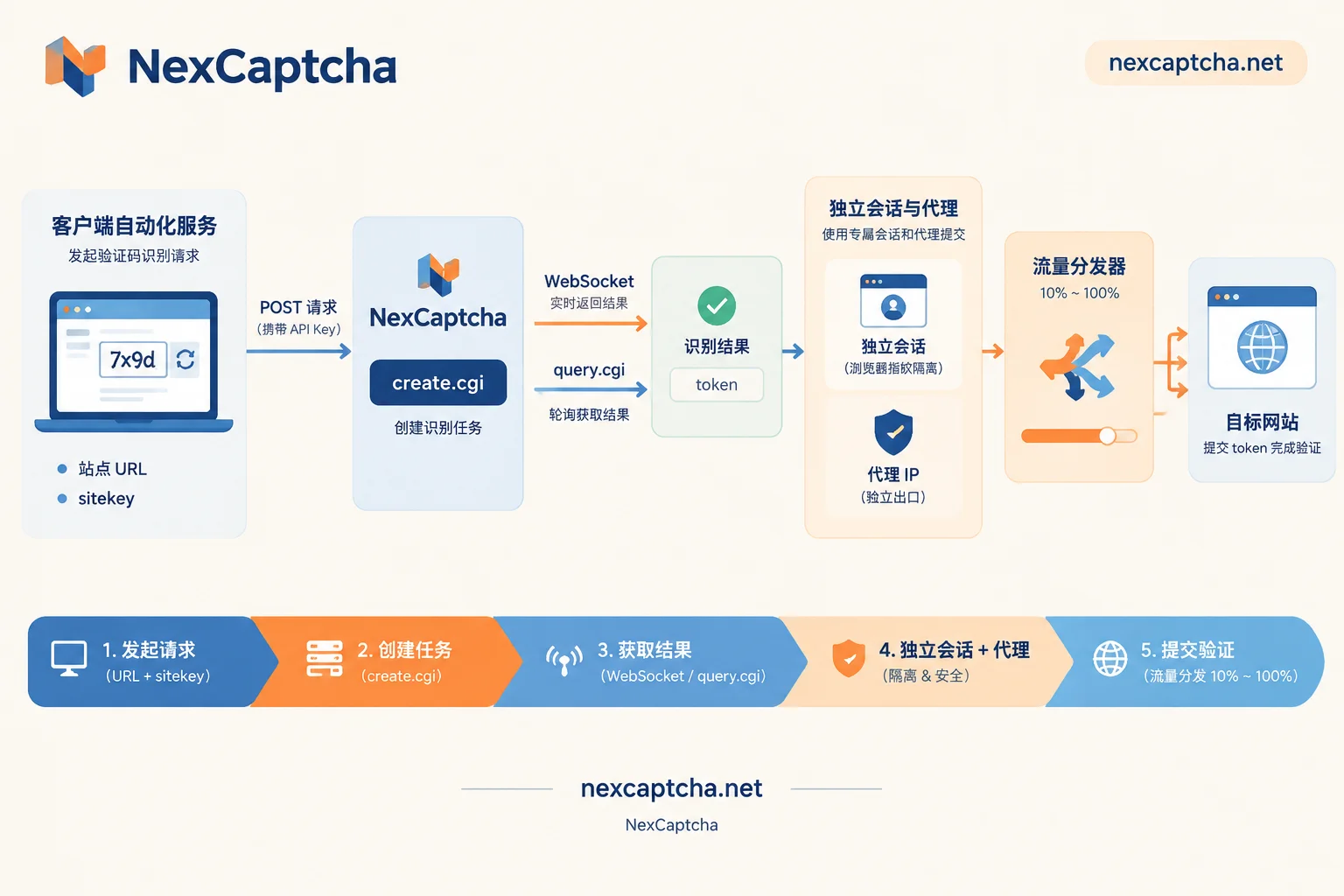
Note that NexCaptcha's API endpoints are create.cgi and query.cgi, not the traditional createTask/getTaskResult format, so existing code cannot be migrated simply by replacing the domain. However, to reduce developer modification costs, we have made parameter design highly compatible:
Step 1: Map Common Task Types and Adapter Parameters
Open the NexCaptcha API documentation, and you will find that under each CAPTCHA type, the corresponding industry-standard task type name is clearly indicated (e.g., RecaptchaV2TaskProxyless).
When constructing requests, the outer layer specifies the type via product code, while the fields inside the adapter object directly follow the customary notation of the createTask system (such as websiteURL, websiteKey, etc.). You only need to rewrite the outermost HTTP request wrapper, request header API Key authentication, and status code parsing logic.
Step 2: Use the Console Online Test Bench for Quick Debugging
Before modifying business code, there is no need to write scripts and test blindly. After logging into the console, each CAPTCHA type is equipped with an online test bench. Enter your API Key and target site parameters to launch a real task on the web page and intuitively verify the returned data structure and latency.
Step 3: Dual-Run by Traffic Proportion, Switch Fully After Verification Alignment
For core collection or automated testing pipelines in production environments, avoid "one-size-fits-all" replacement (for specific migration details, refer to "How to Choose a 2Captcha Alternative" and "How to Migrate from Anti-Captcha"):
- Introduce a simple routing switch at the scheduling layer, first allocating 5%~10% of CAPTCHA traffic to the NexCaptcha interface.
- Compare the end-to-end latency of both sides, the target site pass rate after Token injection, and the effective cost per thousand calls.
- After confirming that all metrics are stably aligned, gradually increase the traffic proportion until full switchover.
Conclusion: Leave Your Energy for Core Business Logic
Within compliant business boundaries (Note: NexCaptcha strictly prohibits using the service for credential stuffing, account theft, bulk registration, spam, ban evasion, payment fraud, or bypassing paywalls/DRM and other violations), CAPTCHA recognition is essentially infrastructure engineering. Rather than spending expensive R&D hours maintaining fragile local OCR models or paying for high-latency general large models, it is better to leave this part to a continuously iterating professional API.
Whether you are building complex multi-scenario automation and data collection workflows or want to optimize your existing CAPTCHA solving costs, you can now register for NexCaptcha for free to get an API Key and test credits (no card binding required). If you encounter any issues during selection evaluation, special sample pricing, or migration debugging, feel free to contact our technical support team via Telegram.



